Translate

Tuesday, 26 September 2017

Part 5: Sub Fusc and Other Weird Oxford Traditions from the Medieval Times

Oxford is a strange place.

                It is not at all out of the ordinary to see monks walking around Oxford. Catholic monks dressed in long white robes and sandals. First time I saw it I did a double take, like Did I just get transported into another century? But after a while I got used to it. A neighbouring student building, St. Benet’s, has a live-in monastery for Benedictine monks.

                I kid you not: one of my friends once saw a group of them SPEAKING IN LATIN to each other in the street. In Latin. In 2017. Need I say more?

                If you ever wished you lived in the medieval times, Oxford is the place for you.

Matriculation

                When you first get inducted into the University of Oxford, you go through this weird ceremony. It involves you wearing this.

Little Ruth at matriculation, taken on the terrible camera phone I had at the time

                This is not a normal outfit. What is this stupid gown that has flaps on the sleeves? If I wanted to look like an idiot, I would have said so. But at least for matriculation, you all look like idiots together, so it isn’t so bad.

                It’s quite fun for all the city residents and tourists though, to see a few hundred young people walking through the street looking like that.

                Matriculation is mandatory and from what I remember it cost about £30 or so for the complete outfit, known as sub fusc. The commoner’s gown, the mortarboard – which, incidentally, you are not allowed to wear until you graduate (stupid!), but need to carry with you at all times – and the velvet ribbon. That’s for the ladies: the men had to wear dark suits with white bow ties and the gown on top. There were also scholar’s gowns, which looked much nicer, but cost about two-thirds more, so even though I could really have gotten one as I was a choral scholar, upon being told it was more for academic scholarships, I decided I’d keep my money.

                What happened in the matriculation ceremony, you ask me?

                A lot of bowing, and many words of Latin were released into the air to deaf ears. (Because again, we’re not fluent in Latin.)

Sub Fusc

                We’ll come back to the university’s obsession with Latin later.

                Now, let’s talk about exams and how strange Oxford makes them.

                Forget about the fact that we call mock exams ‘collections’. I have some even weirder info for you. You know that weird uniform I was just telling you about which consists of us looking like bats? Well, we have to wear that for our exams.

                At any other university – for goodness’ sake, even Cambridge has ditched this odd tradition! – you go to your exams wearing whatever you want. You ought to feel relaxed in what you wear, seeing as you feel tense and angsty in every other aspect of your being, right?

                Not if you’re in Oxford. If you’re in Oxford, you have to wear your sub fusc to a tee.

                You have to wear tights with your skirt, or black socks which cover your ankles if you’re wearing trousers. Yes, even if it’s 28 degrees. And you have to wear your stupid black gown on top of your white shirt. And you can’t take it off until you get into the exam hall. So there you stand sweating. I feel especially sorry for the guys, considering they have to wear their dark suits as well!

                And thou must not forget the mortarboard, the square hat that you’re not even allowed to WEAR! Because of course, if you don’t wear it, you are not dressed in full sub fusc, according to university guidelines. Guess what, heading down to my exams, having managed to get myself relatively calm, I had to run back to my room to get my mortarboard because I didn’t want to risk not being able to sit my exam because I didn’t have a stupid hat I couldn’t wear with me. I mean, it doesn’t get much more ridiculous than that. (But once I realised, and I really couldn’t be bothered to go back, so I didn’t! Shh, don’t tell – they never noticed.)

                I’ve heard that people that are not wearing satisfactory socks have been turned back from their exams because they were deemed to have been dressed inappropriately.

                Do you know, twice in my time at Oxford – in my second year I believe, and again in fourth year, there was a vote at the OUSU Council on whether or not we should keep or get rid of sub fusc? And BOTH TIMES the majority voted to keep it. I just don’t get it. There were so many good reasons to get rid of it: improved comfort; less stress; money saved; no reinforcement of ancient elitist Oxford culture which so many people feel left out of… but it still won. I think that says a lot about who still runs Oxford.

                Oh and of course, there are the carnations.

                There is a long-standing tradition in Oxford that on your first day of a set of exams, you wear a white carnation, pinned to the lapel of your gown. Then for all consecutive exams, excluding the last one, you wear a pink carnation. And then, for glory day – the final day of exams, when your freedom arrives – you wear a red carnation. This tradition is so commonplace in Oxford that the florists sell carnations in a special pack of three with a dressmaker’s pin especially for Oxford students.


A very happy Ruth on the last day of her Prelims (first year exams)

                They say it’s not compulsory but I’ve heard that the only reason some invigilators will allow for why you don’t have your carnation on is it that you have hay fever. Seriously?? As if actually sitting your exams and knowing your stuff wasn’t stressful enough, you have to worry about whether or not you have a carnation, whether it’s the right colour, and whether or not it is alive or dead when you pin it on. And then you have to worry about keeping it on. Worries I could do without on exam day, I reckon!!

                I really didn’t care much for the carnation thing. Once I’d got my carnations, I made them last even if the petals were curling up and turning brown and the stem was starting to go mouldy. (I’d just trim off the over-moist bit.) I’d much rather spend my time revising my quotes than walking 15 minutes to the florist for something as superfluous as a carnation! Also, my carnations often fell off on the way anyway, or during the course of the day. So it really wasn’t that deep for me. It was a frequent favour people asked on the college-wide Facebook group though: Does anyone have a spare pink carnation? I have an exam in an hour and mine has died! #Oxfordproblems.

Graduation

                The most ridiculous ceremony I have ever been part of. It was streamed online so some of my friends got to watch, and they were completely confounded.

                The introduction was in English. It was the only part spoken in a language I understood. The rest was in Latin.

                The proctor defended this for most of his speech, saying that “some people” might find it strange that the ceremony is conducted in Latin, but this is how it was done in the 1000s and so this is how we continue to do it. Alright then mate, if we had that approach to all of life we would still be doing a lot of terrible things because “that was how it was done back in the day”… Oh wait, Oxford already has that approach to everything.


                I have friends that studied Classics (Ancient Latin and Greek) that didn’t even understand all of the ceremony. So what hope did I have?

Luckily, our families in the audience had translations in the programmes they were carrying. We didn’t. So we sat through our own graduation ceremonies barely comprehending a word.

                Though there were some things we understood. When the proctor read out Engineeringaria and Computeria or some such invented word to denote subjects that obviously didn’t exist in the time of the Roman Empire, my friends and I couldn’t help ourselves. We burst out laughing. The absurdity was just hilarious.

                At several points in the ceremony, two proctors walked the length of the hall, to the door and back, holding their sceptres. Just because. Apparently it represents soliciting the votes of the Deans, allowing students to be admitted to their degrees. If you’ve ever seen two grown adults walking back and forth silently up and down a hall you’ll know it’s pretty hilarious. You could see a mix of embarrassment and amusement on their own faces.

                There was also a frightening recurrence of people taking off their soft caps or mortarboards (only certain people are even allowed to wear their mortarboards inside – not the common graduates of course!) before anything could happen. The three Proctors, sitting on their thrones like royalty, would do this about three times. It was ridiculous.

                You know how at a normal university, your name is called out and you go up and get your certificate from someone and shake their hand? We don’t do that. We actually get our certificates sent to us in the post a month later, and instead of going up separately, we go up in a massive group. One of the people in this group has to hold hands with the Dean. (Yes, really. Thank God it wasn’t me.) And then comes the bowing.

The bowing. I’ve watched the video my Uncle made of me walking up and it turns out we bowed EIGHT TIMES. The Proctors watch you all bow to them, three consecutively, and then stand, and bow again, and again, and again… I felt like I was part of a pantomime. I was on the front row and I really couldn’t stop myself from smirking.

And of course after you hear a long paragraph of Latin you don’t understand, you have to respond with ‘Do fidem’ (apparently it means I swear) – yet you don’t even understand what you’re swearing to.

                After that you leave as everyone claps for you, and you come back with your fur hood attached to your graduation gown. This means you have officially been conferred with your degree from the university.

                Once the ceremony’s over, you stand outside and have to keep donning your mortarboard to all the university officials as they leave the premises.

                The whole thing was just a complete joke. But the graduation gown did look nice.
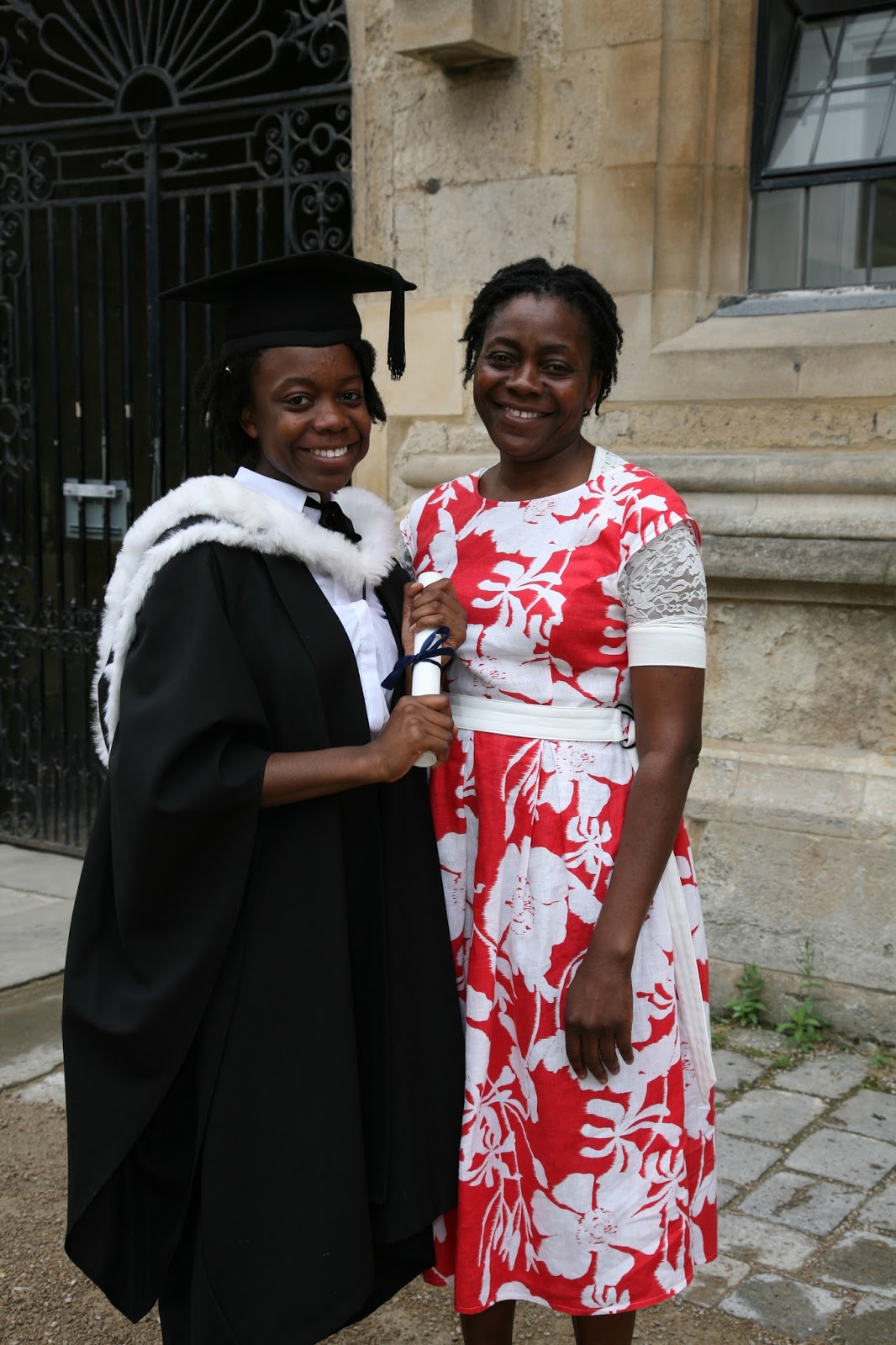
With the living legend that is my mum.

Click here to continue reading... Next post:

Part 6: The Work.

Part 3: Oxford and its Quirks (Good and Bad)

OK, so I realise so far I might have painted quite a bleak picture of Oxford life. Forgive me, but I like to be real about things. I could have told you what you might want me to hear, speaking as an alumna of what has just been voted as the best university in the world.

                As I’ve stated before, I am not by any means saying that Oxford was all bad. I’m simply being honest about my impressions and feelings about being part of its community for 4 years.

                There is no doubt that some of my fondest memories were fashioned in Oxford. I made some of the greatest friends ever in that place, many of whom I’m sure I will be friends with for life.

COLLEGE LIFE

The college communities of Oxford make it possible to get to know people on a much deeper level than you may get at other universities. Composed of over thirty colleges, Oxford allows each student access to a close-knit community of fellow students of many different subject ranges. I’ve spoken to some of my friends at other universities about this and they say that most of their friends are on their course, because they don’t really come into contact with those studying other subjects.

                Somerville was my college, and I am glad it was. It is one of the more inclusive colleges in Oxford. I never felt out of place at my college; I felt welcome. Not so at some other Oxford colleges, for example, Christ Church. As well as originally being a women’s college, Somerville was committed to levelling the playing field in other arenas.

                Even though Somerville isn’t one of the richer colleges, … OK, hold up, I’m going to have explain this. Yes, Oxford University is one institution. Yet each college is different in its own way. As well as differing in the times that they were founded, having different principals presiding over them, separate accommodation and separate choirs and sports teams, Oxford colleges can also vary drastically in how much money they possess. My college is in fact owned by St. John’s College, a much larger and you guessed it, much richer college five minutes up the road.

                It’s no surprise that a college rich enough to buy another college’s land is going to have much more to offer its students. My friends at John’s could get up to £500 worth to spend on “academic-related” products. So you could get a tablet for free. Not so at Somerville!

                A student’s financial expenditure could also vary drastically depending on which college they attended. Thankfully, my college was very good at subsidising things like meals, so although we had to put down a mandatory deposit towards catered meals at the beginning of each term, we didn’t have to pay more than £75/80 each term, and if we did not use up all the money allocated, we could get our money back at the end. That wasn’t so for my friends at Pembroke, who have to pay for “formal” meals every week, regardless of whether or not they go to them. And they don’t get their money back. Plus, their food isn’t even particularly good.

                I’ve never understood why, although attending the same university, a student’s experience should differ so enormously from college to college. I don’t think it’s fair, and many would agree.

                However, the collegiate system itself does work quite well in practice. Somerville was in many ways like an extended family, where every time you walked across the quad (big grassy lawn found in every Oxford college) [Oh and yes at Somerville you can walk on the grass – a privilege you don’t get at some other colleges! Proof that we’re less stuffy.] you would bump into someone you knew and have a five-minute chat. Through living together, sharing kitchens and just everyday college life, you got to know people really well – whether they were in the same year as you or not. I liked that.

The entrance from my college,  Somerville. (That was my brother's hand, LOL.)

BUSTLING SCENE

                Oxford is not a boring place. There is ALWAYS something happening in Oxford. Whether it’s a big shot coming down to the Union, or a big sports event between Oxford and Cambridge, or the big Christian Union-organised annual carol services, there’s something for everyone. There are new societies set up pretty much every term.

               In my time in Oxford I got involved in as much as I possibly could.

                I was a member of my college choir; my college Christian Union and the university-wide Christian Union played a big part in my student life; I loved my church; I joined the athletics club; was part of the ACS (African and Caribbean Society) – admittedly more in my second year than any other year; I’ve already mentioned the Oxford Union; was heavily involved with Oxford Students for Life, the university’s pro-life society; was part of Rhodes Must Fall; was part of Somerville Music Society; Somerville Writing Group; the university’s Alliance Française; a gender equality group set up at college known as the 1920s Society; and even performed in a little play during the Cuppers competition led by the Dramatic Union in my first year!

                If anything, the problem was that there was TOO much to do. For someone with as many interests as me, the hard thing was admitting to myself that I couldn’t do everything. To this end, I did have to let some things go, but in my second year I got to have the most fun – because I had NO exams! I’m glad I got a year off exams so that I could fully enjoy university life without quite as much stress, but in retrospect, having survived finals, I wouldn’t have minded if they had been split over a couple of years instead of being spread out over a few weeks!

INTELLECTUAL DEBATE

                A lot of people that have left Oxford talk about how they miss the intellectual debate that is part of daily life there. It’s only been a few months for me so I haven’t felt it yet; besides, I seem to end up having deep conversations with people wherever I go!

                But that was another of the things I liked about Oxford. Unlike some groups of people I’ve been with, where the conversation can go on for 10 minutes about what kind of foundation or nail varnish is best – boring and completely irrelevant for someone who doesn’t wear make-up! – in Oxford, our conversations would often centre on ideological viewpoints, like the key issues behind politics and faith. Conversations were never boring.

                They could get quite heated, though. See, the thing about Oxford is, a big part of the reason people got there is that they can express their views confidently. That sadly leads to a sense of entitlement and arrogance about some people when they speak. Some people want to have a discussion with you where you exchange views and listen to one another’s points of view. Others just want to shout you down without giving ear to your opinions. That did get on my nerves.

                One of the things my friends and family told me before I went to Oxford was, “Make sure you don’t turn into one of those arrogant snobs!” And I pray to God I didn’t. I actually think I would cry if someone told me that post-Oxford I have turned into an arrogant snob. Because arrogance is one of those character traits I can’t stand, and I’d hate it if that became part of who I am.

CENSORSHIP

                Now, I’m far from your typical Oxonian. As I said before, I’m a black, female, Mancunian, Christian Oxonian. Proud of each of those adjectives, but probably none more so than that last one. Christian. I didn’t choose to be born black, be born a girl, be born in Manchester, but I did choose to become a Christian. Each forms an important part of my identity, but my faith is the one that shapes me the most.

                And in Oxford I regularly felt as though I was under attack because of my faith.

                This isn’t a pity party: I’m not new to this. Christians are supposed to be persecuted; it comes as part of the package.

                I get that some people don’t believe in God. I get that some people think “organised religion” (even though that’s not what Christianity is to me) is stupid. I came to realise that the most widespread worldview in Oxford was liberal atheism. But I don’t get how placing views that are anti-religion and anti-Christianity on a pedestal is fair.

                And I saw that happening time and again in Oxford.

                I simply gave up on OUSU, Oxford University Student Union: aka the organisation which every student contributes to and which holds itself to representing the entire 22,000 student body – because I felt entirely unrepresented by it.

                Yes, as a Christian there are certain things I believe that go against the grain of wider society. I believe in the Bible, a book which hasn’t changed even though society has.

                One of the things that I believe which is shaped by my faith is that life begins at conception. I am pro-life. (I'm pro-life and I don't see why that's a problem.)

                So are a lot of other people, and not all of them are Christians or follow any faith at all.

                OUSU didn’t care about them. Debates on pro-life matters were regularly shut down in Oxford. One was with the claim that a debate over whether abortion culture was harmful to wider society would pose “security concerns, both physical and mental” to students. Twice I went to OUSU Council meetings where the opinions of pro-life people like myself were completely discounted. Although the student union claims to represent the entire student body, it already has a “pro-choice” policy. That means from the offset they are biased towards those that are in favour of abortions, and against those who are not. I don’t really see how they can in so doing, represent the entire student body.

At the first [of these OUSU Council meetings], there was a proposition on whether or not OUSU should donate £200 (which, by the way, is about a quarter of OUSU's annual budget) to finance an abortion campaign. I spoke quite impassionedly against the motion, and there were quite a few people out there on the same side as me. But of course the motion passed. After all, this is a student body that is already committed to donating £50 to Abortion Rights each year.

Again, two weeks before I was due to leave Oxford, a motion was discussed calling for the pro-life charity, LIFE, which supports women through pregnancies and helps terminally-ill patients across the country, to be banned on university grounds. Come on now, this is not an ISIS-supporting network, it is a charity that does a lot of good across the nation. But it was being touted as though it were an extremist breeding ground. One girl said that the claim that abortion is linked to post-traumatic stress, depression and ill health is COMPLETELY UNFOUNDED and that LIFE was making it all up.

                I got fed up. I got annoyed. I got frustrated. And then finally I figured, I’m leaving this place in 2 weeks anyway, I don’t have to deal with this rubbish anymore. And I walked out of the meeting.

Never have to deal with OUSU again.
That was after 4 years of it. Four years of having my beliefs constantly rubbished and hounded. Sure, I can walk out because I’m done with Oxford now, but my heart is not happy thinking of all the other Christians or people who have similar belief systems as me being hounded and silenced across the university simply because the way we see the world doesn’t fit the way they WANT us to see it.

Click here to continue reading... Next post:

Part 4: Student Life in Oxford

Part 4: Student Life in Oxford

                You may think – I did too – that students would be well-behaved at Oxford. That the “crazy” bug that most students seem to catch just wasn’t in the Oxford air. Not so.

                People getting so drunk that they get their rooms mixed up with the floor above and attempt to walk into other people’s rooms at 3am? Happens in Oxford. People doing weird initiations which involve them attempting to carry cookers into their peers’ rooms at 4am? Happens in Oxford. People leaving their food in the fridge for over 6 weeks so it develops three layers of mould in 5 different colours? Happens in Oxford. Students leaving the kitchen in such a state that you want a bulldozer to knock out all the grime so you don’t have to touch it for yourself? Happens in Oxford.

                Students are weird.

                I have the same types of stories that most students that lived in halls of residence have. (And yes, all of the above really happened.) People stealing my stuff from the fridge? Tick. The worst time was when a friend had bought me a brand new bottle of milk when he went out for his own stuff and by the following morning someone had drunk half of the bottle. But I have friends for whom it was actually quite a big problem – people would steal their food so often that it got to the point where my friends were actually going to be out of pocket because of the unidentified thief. I don’t get that kind of selfishness. If you need some food, just ask! Most people are kind  enough to share. But to take and just keep taking without asking – when you know that none of us students are rich? That’s just rude.

                We got into the habit of labelling our food to deter the thieves. And I would generally keep as much food as I could in my room to make it impossible. And after a while, my pots and pans too because those started to go missing as well.

                I was pretty naïve before I started university. I mean, I didn’t live in a bubble, but… I don’t drink, I don’t believe in sex before marriage and I don’t go clubbing – so a lot of stuff that your typical student would get involved in I didn’t do.

                You could say I had a bit of a wake-up call at uni.

                Halfway through your Oxford degree, you have this thing called “Halfway Hall” to celebrate having made it – you guessed it, halfway through your degree! We did the usual Oxford formal thing of having a sit-down meal with three courses and then… the sconces came.

                I didn’t know what sconces were before that and I made sure I never was present when they were done again! #SCARREDFORLIFE.

                Sconcing is this weird Oxford tradition which involves people standing up and saying: “I sconce anyone who…” It usually happens at crew dates, which I had purposely avoided to date, but it weaved its way into the end of Halfway Hall. (Disclaimer: all the tutors had left by the time this happened.) You can imagine my horror as people stood up saying things like: “I sconce anyone who has ever had sex in the shower” and ditto in the LIBRARY, and my friends stood up, including those sitting opposite and next to me. It took a while for me to be able to look at them again in the eye.

                In short, strange student behaviour happens in Oxford too. Just at other unis I might not have ever found out. Or at least, not quite in the same way.

The Oxford Vocabulary 

                I’ve already said it but I’ll say it again: Oxford is weird.

                It is such a weird place that it has its own dictionary. As in, we use words that no-one else in the English language uses.  Or at least not in that way.

                What does “scout” mean in everyday English? A young boy or girl who is a member of the movement founded by Lord Baden-Powell. In Oxford English, it means “cleaner”.

                Some of my friends really quite disliked it that we had scouts. They would come to your room every weekday morning to collect your rubbish and would clean the kitchens and vacuum the floors. As well as clean your room once a week. One of my friends pointed out that having someone do things like this for you meant that you weren’t learning any sense of independent responsibility for taking care of your own mess.

                That is true to some extent, I think. However, the scouts being there doesn’t prevent you from keeping tidy autonomously, it simply makes it easier to do. Everyone knows the work we get is so much, often we barely have time to sleep – so keeping completely on top of cleanliness single-handedly would probably be a hard job. That said, some people really did take advantage of the scouts. We would often have the same sign above the grimy message in the kitchen for days on end: ‘Please clear away and wash your dishes. The scouts are not responsible for your dirty dishes. If these items are not removed by this Friday we will throw them away.’ Come the following Monday, Tuesday or even later and there they would still be, untouched by whoever made them such a mess in the first place. It was just so disrespectful, and also unfair to everyone else who had to use the kitchen. That’s part of the arrogance that I was talking about earlier. Though I don’t doubt that similar things happen at other universities too.

                ‘Porters’ and ‘lodge’ are a few more useful words which you frequently hear in the Oxford vocabulary. Porters are the people who look after the college entrance (the lodge), and are effectively our security guards. They also handle our post and answer a lot of our queries. The porters at Somerville are some of the friendliest human beings you will ever meet; I would regularly stop by just to have a chat with them! I miss them already.

Trashing

Another useful word to know within the Oxford dictionary is ‘trashing’. Finals and other exams are so intense that once you have gotten to the end of your last one, your friends come along to throw things at you in celebration. Silly string, confetti… Some spray alcohol. You’re actually not allowed to throw food, and to that end security will check your bags going in. But people still throw them once they’ve left the premises: baked beans, flour, chocolate sauce…

                I didn’t get any food thrown at me and trashing. I banned it, and my friends kindly obliged. I did get a lot of glitter in my hair though! I also got handed and crowned with a lot of silly accessories.


I actually didn’t get trashed in my first year, so getting trashed in my final year was my first experience, and I loved it! All your friends line up behind a gate to greet you. It feels like they’re part of the culmination of the joy you feel once your exams and all related stresses are over!

                Afterwards, some people would jump in the river. The very dirty River Cherwell, which is full of eggs and stink every summer because people have gotten baptised in it after being doused in food. This is something I don’t like about the trashing tradition: it does sometimes just go too far. Also I don’t think anything can live in that river with all the rotting food in it. (You can bet I didn’t jump in it.)

Balls

                If you’re studying at Oxford, you should try and get yourself to at least one ball in your time there.

                I’m not gonna lie: I did like the balls. They were an opportunity to dress up and have fun with your friends, and do stuff you don’t generally get to do in normal life. Watch and dance along to live jazz music, be part of a silent disco, and feel fancy!

                Though they were ridiculously expensive. And I mean, ridiculously expensive. Your average ball would not be cheaper than £90. The RAG ball, which happens every November, donates its funds to charity – so that you feel better about paying for. And Oxford Union balls, for members, were about £50 – so they were the cheapest, yet if you’ve already paid close to £240 for membership it makes sense that you should get your balls a bit cheaper! 

In my last Oxford ball – at the Oxford Union, of all places – the one that declared itself institutionally racist, I decided to go in traditional Nigerian dress to make a point!

The grander, bigger balls could cost up to £200. Those were the commemoration balls, celebrating the amount of time a college had been in existence – 200 years, 500 years, etc. But get this: they would be split between dining and non-dining tickets. That meant you could pay £155 for a ticket and you wouldn’t even get a proper meal!! So tell me, please, what are you paying for?!

Formals

                Formals are similar to balls in many ways. Again, you should make sure you try these out if you do go to Oxford.

                They consist of a sit-down meal of three to four courses in your college’s dining hall. I would say the food is always fancy, but I’ve been to some friend’s colleges where it really wasn’t... The standard and feel generally depends on how many formals a college typically has in a week. At Somerville we would usually have one per week, so the food would be much fancier and people would get properly dressed up. (Not in ball gowns, but in cocktail dresses and such. If you’re a guy it’s easy – just wear a suit.) At other colleges, where formals happened up to three times a week, people would just wear jeans and then throw their gown on top (I will explain the weird Oxford clothing in a bit.)

                I liked formals. They were a good chance to enjoy a nice meal and good conversation with your friends. And get away from work.

One of my last formals at Somerville with one of my very good friends in Oxford! (We were the only black people doing French by the time we finished, haha!)

                The only bit I found really weird was the weird Latin you always had at the start. You and your fellow students would be seated, and then suddenly your tutors and the College Principal would come in. As a sign of respect, you would all hush and rise to your feet. You would remain thus until at Somerville, the Principal had uttered the words: ‘Benedictus benedicat.” Which apparently means, ‘May the Blessed One give a blessing.’ (I didn’t know that before writing this, I just Googled it. We all thought it meant, something like “bless us”. Because we’re not fluent in Latin.)

                NEWS FLASH: Oxford is obsessed with Latin. No, not just Latin, the medieval times in general. I’ve never seen anything like it.

Click here to continue to the conclusion...

Part 5: Sub Fusc and other Weird Oxford Traditions from the Medieval Times.

Part 2 - Oxford: At Odds with the Real World

OXFORD AND ITS WAYS…

Was I apprehensive about Oxford? Yes, in many ways I was.

                One of my friends at church when I told him I was going to Oxford said, “You’ll be the first black person there!!” Hilarious, but gives you an idea of the kind of impression that Oxford gives people of its racial mix-up.

I am used to being the only chocolate person in a milk-coloured environment, though. Although my first primary school was majority black, my second primary school was in a small, upper-middle class white town and I was the first black student they had there in 101 years, by the time I joined! (If you were wondering why, it was because my mum worked in the next town and logistically it was just easier.) At my secondary school I don’t believe we ever had more than 13 black students in a school of around 1,300. (I counted. And there were no black teachers.) There were two of us in my year (and we happened to be in the same form), until we got to sixth form. Then it was just me.

                It didn’t bother me at all. I had my friends, and it didn’t matter to them what colour I was. And as Manchester is a very diverse city culturally and ethnically and my school wasn’t far from Manchester, ignorance wasn’t something I had to deal with very often. (Definitely less than in some other circles).

It was just as well I’d gotten used to being the only black people in a lot of my social circles, as I was very often the only black person in a lot of places in Oxford. I was the only black person doing Italian in my year and I was the only black person in choir. In many other circles I was one of about two or three black people.

                Although I was pretty used to being the odd one out colour-wise, I realised that in Oxford I was pretty much that ALL THE TIME. You could literally play a game of “spot the black people in Oxford”. No joke: it literally became a thing walking down the cobbled streets of Oxford that when you passed a fellow black person you’d give them a little nod and smile, as if to say, “Well done for getting here, I know there aren’t many of us!” On the other hand, some black people seemed to quite deliberately avoid all other people with the same colour of skin as them. Guess they were trying to play a game of assimilation.

                And of course such a lack of diversity plays into abundance of ignorance. I was shocked after my first term at Oxford at the plethora of actual stupidity I heard every time I went to an Oxford Union debate. The things that people would stand up confidently and say about ethnic minorities and women and working class people would actually leave me speechless. It’s largely because of the culture of places like the Oxford Union that I say that Oxford is a rich white man’s paradise.

The Oxford Union

                The Oxford Union (not to be confused with the Oxford University Student Union, which I’ll talk about more later) is one of the oldest debating societies in the world. Founded in 1823, it prides itself on having brought great thinkers and speakers to the doorstep of Oxford students for centuries. I loved going to Oxford Union events, but the Union was also a very large thorn in my flesh.

                The Union is really tailor-made for members of the elite. For one thing, membership currently stands at £262.65. Admittedly, this is life-long, meaning that once you have been an Oxford Union member you remain so for the rest of your life. HOWEVER, everyone knows students are not exactly the richest people in the world, and not many people just have £262 to give away. I debated for some time over whether it was going to be worth becoming a member, but decided in favour in view of the fact that: one, Freshers in the first few weeks were eligible for a discount which reduced the membership price by about £30; secondly, I could go to a large range of events with people present that I would possibly never meet anywhere else; thirdly, I could go to these types of events as many times as I wanted.

                The Oxford Union was honestly one of my favourite things about Oxford. I got to meet people that I had admired and respected for years: Doreen Lawrence, Greg Rutherford, Emeli Sandé… The most riveting event I went to was a Black Lives Matter panel we had in my final year where the mothers of young black men murdered in America addressed us, including the mothers of Trayvon Martin and Sandra Bland. I cried in that one, I was so moved. I even went up to Trayvon Martin’s mum afterwards and gave her a hug; so much did I feel her pain.

(Below is a video of Sandra Bland's mother speaking at that riveting Black Lives Matter panel.)

 But it was also the bane of my life.

                As well as the assumption that everyone has that much money – OK, so the Union now has a special Access membership rate, but I don’t remember that being a thing when I was a Fresher – the Union was obsessed with flaunting this image of opulence that was completely unnecessary. At every debate the President, Librarian and other members of the Standing Committee would dress in white tie – so the guys in black suits, and the ladies in posh ball gowns. If you were a girl on the Standing Committee, you’d be expected to wear a different dress to every debate. OF COURSE this puts off those who don’t have the financial means to own eight different posh gowns. It also makes a lot of people feel like they don’t fit in. Most people that end up having positions on the Standing Committee come from a private school background, and from some of the most prestigious in the country – think £30,000-a-year Eton, St. Paul’s…

                The best way I can explain the very prevalent attitude which annoyed me so much in Oxford was that which comes from “living in a bubble”. I’m not slating people for going to public schools, but I do slate them for the wilful ignorance that their background enables and perpetuates. So many people, by virtue of having gone to schools where they only interacted with rich white young boys like themselves, simply had no inkling of how “the other half” lives. They knew nothing of prejudice, living on a regular income, had no shame in talking about women any which way…

SERIOUS SEXISM

Towards the end of my first year in Oxford, the then President of the Oxford Union was arrested on charges of rape and attempted rape. The whole thing kicked up a storm which abated only once the charges were dropped months later. In the whole event, the student refused to take a leave of absence, which angered many.

                Irrespective of the fact that he was released without charge, such an influential figure being accused of so serious a sexual crime threw the epidemic of “laddish culture” into the limelight in Oxford. Now, laddish culture isn’t something that runs rampant only in Oxford, of course. It’s a problem in universities across the country. But the brash arrogance that it is coupled with in elitist institutions like Oxford doubles its force.

                In my second year in particular, things appeared to take a turn for the worst. I’ve only recently discovered just how bad things were and actually that I knew (or thought I knew) some of the people that were responsible. At my college there were supposedly a group of boys that latched onto the Freshers in particular, but specifically took advantage of younger girls. I’ve even heard people talk of “pimps”. What was going on led my college principal, Alice Prochaska (love her!) to talk to the media about the very worrying behaviour taking hold on our university grounds: she wrote an article for The Guardian (available here: Tackling Laddish Culture, Alice Prochaska ) and spoke on Radio 4’s Today programme. Sexual consent workshops are now standard in Oxford.

So, we’ve made headway in that department. Things are changing for the better. But there’s no doubt that it’s a work in progress.

RIDICULOUS RACISM

      On race-related issues, you can forget it. Oxford gets a big thumbs down from me. I’m talking about Oxford, the institution, the power – not individual colleges or individual people.

      Fortunately I generally had a good experience as a black person in Oxford. I didn’t come up against some of the downright malicious comments that some of my friends had to deal with. But I did come face-to-face with ignorance very often and as a black person, was made to feel collectively marginalised.

      I’ll bring the Oxford Union up again as an example.

      Why, tell me please, did the Union have to invite the French right-wing nationalist Marine Le Pen to speak uninterrupted for 45 minutes on her very, very worrying views? Why give a platform to someone of her nature in a place where ethnic minorities already feel marginalised and unwelcome? What, you just want to air her nasty views because “everyone has a right to free speech”? You mean to say by letting her give a speech on why it’s OK to be racist and Islamophobic you are not condoning her views? OK, so why didn’t you have her as one of the speakers in a debate with four people on each side as you so often do?

      Some say that giving someone with unintelligent and unfounded views a platform to speak and then pointing out the holes in their arguments actually makes them look stupid. OK, maybe so. But how exactly does that work when the person chooses the questions she wants to answer and ignores the rest? And how does it work when the woman barely speaks any English and thus you have to do everything through a translator; her own translator, who can water down what he likes as he communicates from one party to the other? Come on, now.

      I didn’t go to that event, if you didn’t guess. I actually went outside the gate – to PEACEFULLY protest, believe it or not.

     An invite from the Oxford Union is a big compliment to anyone. It says, “You are important. People like you and want to hear your views. WE, a prestigious institution, like you enough to want to have you address our members. We value what you have to say.” Ask anyone that’s been invited to the Oxford Union and they will definitely not tell you they took it as a snub. 

So, ahem, WHY, did Marine Le Pen receive this honour? (And yes, if you were thinking, “I bet Ruth’s glad Le Pen didn’t get elected French President this year”, you were right.)

That oh-so-dearly-loved princess-of-the-people polemicist KATIE HOPKINS has been invited to the Oxford Union TWICE. And that’s twice in the time I was there. For all I know, they might be planning to have her again.

WHY on Earth would you want to hear something new that someone that referred to thousands of migrants drowning in the Mediterranean as “cockroaches” has to say?

All of this is worrying enough.

But I haven’t told you yet about the infamous “Colonial Comeback” cocktail.

That debacle led to even the Oxford Union condemning itself as “institutionally racist”. You might have seen the national headlines which came about as a result of what happened on that night in May 2016.

Along with some friends, that evening I went to a debate entitled:  'This House Believes Britain Owes Reparations to her Former Colonies.' It was set to be a big event. And of course, due to the nature of the topic, there were more BME students there than normal. The mood was lively, spirits were high: there was an anticipatory flavour in the air.

And then we saw it.


Laid out on the wooden tables in the bar were promotions of that night’s specially concocted drink. Coupled with an image of black hands in chains, “the Colonial Comeback!”

I was speechless. I was mad, but the kind of mad where you don’t have words. The kind of mad where you just find yourself trying to figure out what on earth was going through someone’s mind when they decided that on the night of a debate held to question whether or not Britain owes reparations to her former colonies, it was a good idea to advertise an alcoholic drink trivialising the atrocities of slavery and colonisation. There was also another advertisement for the same drink which had a map of Africa partitioned amongst European powers.

I was flabbergasted at the thought that not only had someone come up with this idea and then printed out the leaflets, but someone else had seconded it and laid them out on the table. And it took a group of mainly BME students sitting in the bar to sound the alarm bells. I mean, what were they thinking?

Well, it’s not hard to imagine that we got pretty annoyed. A couple of the people I was with got up and asked why on earth such things were there. There was quite some consternation before the debate began, and the President apologised before the debate began that such an insensitive promotion package had been put forward at all.

But to be honest, I wasn’t happy with that “apology” and neither were my friends. It was just some little “we’re sorry” without understanding the gravity of it. The idea of suggesting that the aggressive foreign policy of colonisation, which involved plundering people’s land, maiming human beings and destroying the culture and livelihood of many people, should COME BACK, is not something we ought to take lightly. 

Well, some people quite literally did not take that sitting down. A small group of the people I had been with in the bar stood up in silent protest. It was that night that the Rhodes Must Fall in Oxford movement began. [You can read more about what went down at that debate here, in an article I wrote for the British newspaper ‘The Voice’.] 

It was largely due to the nonconformist boldness of those four people at the debate that the dialogue surrounding race and racism in Oxford started to change. Flyers for Rhodes Must Fall were handed out after the debate and it got a strong following thereafter. People were waking up to the epidemic of racism in Oxford and wanted to do something to help cure it. If some of the things said at that debate and “The Colonial Comeback!” cocktail weren’t enough, the affront of an attendee in the bar after the event, labelling a student in my year “a black barbarian”, underpinned just how bad things were.

It was obvious to all of us, but the Oxford Union took a while to see it our way. It ended up making three apologies because the first two missed the mark. The third apology was made after a 5-hour meeting in which the Union’s Standing Committee met with leading groups for social change in Oxford, including the Student Union’s Campaign for Racial Awareness and Equality (CRAE) and of course, Rhodes Must Fall. In this apology, the Oxford Union Society condemned itself as “institutionally racist” and committed to holding mandatory race and anti-racism workshops as part of induction into the committee. Good, positive change.

But as much I’d like to say that Oxford’s love affair with racism ended there, it did not.

Not long after all of this happened, I went on my year abroad and so was out of Oxford for a year, and watched events from the sidelines. So hopeful for change when I left, over the course of the year I got more and more frustrated with the system’s stubbornness to change.

Rhodes Must Fall

Rhodes Must Fall really did get up and running in that year. Yet, it was met with so much hostility from every side. People just didn’t want to engage with the issue at hand: that Oxford as an institution celebrates and benefits from the horrendous actions of slave-owners and colonialists to this day. I’m not going to go into it here, but basically Cecil Rhodes was the architect of apartheid and enabled the deaths of millions of black people in Southern Africa. Yet his name is all over Oxford, and a huge statue of him emblazoned on his former college, Oriel, lords it over the High St.

Our Chancellor didn’t get what the problem was. According to him, the last colonial administrator of Hong Kong, people that didn’t like Rhodes being celebrated “should think about being educated elsewhere”. Oh, he’s also known to have claimed that having more BME students in Oxford would “erode standards”. Translated: if we let more ethnic minority students into our universities, everyone will get dumber.

It’s probably not much of a surprise that in a place where views like this are given a platform, change doesn’t go very far.

In December 2015, Oriel College finally started listening to the protests of Rhodes Must Fall: considering the significance of affording such a place of high esteem to an undeniable racist, and recognising Rhodes’ position as emblematic of institutional racism within the university as a whole. We got excited. They said they would consider removing the statue and that in the meantime they would remove the plaque celebrating him, and would place a notice clarifying who Rhodes was and how the college did not condone his actions; moreover that his views were “incompatible” with the “inclusive culture” of a modern-day university.  A six-month discussion, involving the council, alumni and other parties was to take place before the final decision would be made.

Fast-forward six weeks, and it had all been cancelled. No more. Why? Oxford always bows to the power of money. The very, very rich donors to Oriel College were fuming that a colonial racist who is known to have said things such as “I prefer land to ni****ers" might actually lose his position as revered god, and immediately began to threaten to remove their generous funding to the college. Response of Oriel College, and Oxford the institution? “Hold on, we’ve changed our minds. Money, money, money, we need your money, it’s a rich man’s world.” Because OF COURSE, in Oxford, money comes before ethics, compassion, before all else.

I was a lot more hopeful back then about change in Oxford than I am now, a few months after having finished my four-year degree. [For more on Rhodes Must Fall and the aftermath of that decision, you can read the feature article I wrote for ‘The Voice’: Rhodes Must Fall].

My final year was the year in which, like I said before, I truly got fed up of Oxford. I couldn’t wait to leave. Don’t get me wrong: despite the things I have talked about, I had missed Oxford on my year abroad. I had missed my friends, missed being part of the groups that were so intrinsic to my time there: the Christian Union, church, choir… But not long after I came back, the reality of Oxford and its strange ways hit me again.

In the second term of my final year, one of my friends, who had graduated the summer before, had a CCTV image of him circulated around the entire mailing list of his friend’s college, where he had stopped by for the night. He tells the story best himself: https://www.theguardian.com/commentisfree/2017/feb/10/oxford-university-circulate-criminalised-image-black-man. As Femi says, there is no other reason that a porter would send out an email warning staff and students to “be vigilant” and “alert a member of staff [...] or call Oxford security services” if they saw him other than that they feared he was dangerous because he was black. This was the last straw for me. It’s not uncommon at all in Oxford to be stopped around the university grounds because you are black. Most have their own story. I’ve been stopped when walking into college grounds when others, that are white, can walk straight in – because there is this question in some people’s minds of, “Is she in the right place? She’s black, she can’t belong here.” I remember another time I was walking around a college with a friend (her college) and we were asked if we were in the right place, if we knew where we were going. We knew we wouldn’t have been asked that question if we were white.

I would laugh things like that off, though sometimes they did irritate me. I found it amusing and silly that people would get me mixed up with the only other black girl around. That type of thing, and worse, was documented in an initiative called ‘I, too, am Oxford’ in my first year [available here http://itooamoxford.tumblr.com/.] But something as bad as someone’s CCTV image being circulated around an entire college as representative of someone to be afraid of simply because he was black, that was different. It wasn’t a “micro-aggression” or something to wave off lightly.

It made me mad. I was properly mad for more than a week. It wasn’t just this, it was this combined with feeling marginalised by the university as a whole up until now. It was the incident itself combined with the fact that there was no apology made. It was Oxford and its relentless pursuit of “othering” people of colour.

In my second year – which was my favourite year in Oxford, more on that later – I harboured a real sense of optimism about the state of things in Oxford. I believed in change, and was a part of taking steps to make it happen. By my fourth year, I had lost it completely. I was fed up and disillusioned with the static status quo. Now I say: I don’t want my future kids to go to Oxford. Not unless things change. People have been saying the same thing about Oxford for the last 20 years, and the 20 years before that (“when I was there the racism was terrible”, “I felt I didn’t belong because I wasn’t rich, etc etc”) and there still doesn’t seem to be much hope of change. Do I want my kids to experience the same sense of not belonging and continued othering at their university? No. I’d rather they experienced life at a university which is more like the real world. Oxford is not the real world.

CULTURAL CAPITAL

                So many people take their privilege so much for granted that they fail to realise the cultural capital that they have over their counterparts.

                Though English is my native language and I was born and bred in the UK, I am a product of the background I am from. My parents emigrated from Nigeria to study in the 80s and so though although we speak English at home, we don’t speak upper-class Southern English, like some people in Oxford might hear at home.

                Sometimes in classes some idiomatic expressions would come up that I had never heard before, probably mostly because they aren’t widely used anymore, but also because they are used most often by the upper classes. And people would look at me like I had two heads because I didn’t know what they meant. Soz mate, I’m from Manchester and we don’t speak the Queen’s English there. I remember being laughed at by a fellow student once in a translation class because I didn’t know the difference between certain types of guns. It’s like, I’m sorry, but I didn’t grow up in a mansion where the family activity was shooting!

                Now I’m from a middle-class family and I felt like I didn’t fit in with the general cultural capital in Oxford. I mean, I have nothing against them – indeed, a lot of them were and are my friends – but the majority of people in Oxford come from London, Surrey, and Kent. I tell you, every time I heard anyone with the slightest tinge of a Northern accent, I would latch on to them. We were rare.

                If you’re working class in Oxford, I think it’s fair to say you would feel like you didn’t fit in a lot of the time. Some people would be made fun of because of the way they spoke. Think about the amount of balls and formal dinners we have in Oxford each term and that makes you realise even more how much you can be excluded from the opulence of Oxford because of your background.

Click here to continue reading... Next post:

Part 3: Oxford Quirks (Good and Bad)

Part 1: An Introduction to Oxford

Prologue 

Around 2002, a little 7-year old girl sat in the attic-library of her home, surrounded by books. She peered closely at two large ones in particular. One was a thick book with the words ‘OXFORD’ imprinted on its bound spine in bold, and the other was a Cambridge Companion. This sight made the little girl ponder on something, and she uttered the words: “Mum, which one is better, Oxford or Cambridge?”, turning to her mother, who sat a few metres away.

Her mother responded after some thought, “Well, for English Oxford is probably better, Cambridge is generally better for sciences.”
From that moment on, this little girl decided she wanted to go to Oxford.

That little girl was me.

I’m 22 now and I recently graduated from Oxford, so you could say a long-cherished childhood dream came true!

But… All that glitters is not gold. Oxford wasn’t exactly what I had hoped for and expected. I’ve talked about writing about my reflections on Oxford for a long time and here it is, that long-awaited post.

In this post I’ll be telling you things from my point of view, and not very differently to my usual way, presenting things transparently. This is an unfiltered collation of my thoughts and reflections on Oxford, that prestigious and ancient institution known world-over. They don’t have to be the same as other Oxford graduates’ opinions, or the opinions and experiences of current students. I also don’t speak for every female Oxonian, or every Christian Oxonian, or every black Oxonian.  Or every Mancunian or Northern Oxonian. Or every black female Christian Northern Oxonian. You get my drift. This is “Reflections on Oxford, Ruth Akinradewo style”. My opinions and experiences aren’t being put here for debate, they simply are MY OWN opinions and experiences.

OK, now we’ve got that straight… Are you sitting comfortably? Then I’ll begin.

The Prestige of Oxford

                When my mum answered my question about 15 years ago, I thought I would be studying English at university. I have always loved reading and writing. But in fact, towards the end of my school years, I realised that I loved languages too much to let go. French was my favourite subject, and English (Literature) came a close second. Initially I had thought I would keep up English at university alongside French, but after much advice and contemplation, I decided upon French and Italian. Heads up: I didn’t learn Italian at school, so my degree was in French and BEGINNER’S Italian. Craziest decision I ever made I think. Do you know, before electing for that choice I had told myself at all the open days I went to that I would NEVER pick up a language from scratch? Too much stress. I had started learning French at the age of seven; why would I start studying another language at the age of eighteen and then hope in four years to have reached the same level in the first language? No, thank you. Well, a few months down the line and my schoolteachers and my mum had convinced me it was a good idea for me to study two languages to give myself more opportunities, assuring me that I was well capable of learning another language quickly and efficiently.

                Four years later and I have GRADUATED in French and Italian! Crazy tingz.

                I don’t recall many days of my four-year degree going by without me taking a moment to thank God in amazement that this was actually my university. I mean, like I said before, this was a childhood dream, to go to Oxford. Oxford, the university which had existed since the 1000s and was known all over the world. Oxford, the university where some of the greatest world-changers had been educated. Oxford, the location which had unashamed links to the furtherance of the gospel.

                Oxford was MY university. Me, little Ruth who defied almost every possible stereotype of the typical Oxonian. Black, Northern, a Christian, from a state school . . . It amazed me that against all the odds I had ended up in this place. I was awestruck by the amount of opportunities that lay right at my fingertips simply by nature of me being there. I was amazed that I was studying at the same college of the UK’s first female Prime Minister, India’s first female Prime Minister and countless other world-changers (of course Margaret Thatcher did a lot of things that I didn’t like and that most Somervillians despise - but I do have to give her Kudos for being a strong woman in a man’s world!). I could go to the Oxford Union and listen to speakers of the calibre of Jesse Jackson, Malala Yousafzai (who, as it happens, has just been accepted to study at Oxford!), sit in a hall where Malcolm X and Winston Churchill had spoken . . . The history of this place was amazing! Just a few doors down from the oldest debating society in the world was the Methodist Church where heroes of the faith Charles and John Wesley had started their ministry. Oxford breathed history and every day I walked in the trail of it.

My college, Somerville! (On a rainy day.)

                But in the history and age of Oxford also lies some of its greatest undoings. Oxford is the place most stubborn to change that I have ever known. In my final year there I was well and truly done with it.


               People ask me now, “Do you miss Oxford?” No, no I don’t. I will miss my friends, I enjoyed my degree, I loved my church, and I have many great memories of my time there. But four years as an Oxford student is enough for me. I do get quite bewildered when people tell me that they’re going back for a Masters, or a PhD, but Kudos to them if that’s what they want to do – I know being there isn’t easy! But as much as Oxford can bring good things, I would definitely not choose to go back.

            I am generally a positive person and I’m not saying that Oxford was all bad – not at all. Am I happy that I ended up at Oxford? Yes. It was one of my greatest dreams and ending up there helped my confidence.  It helped me believe in myself more and see myself as capable.


The Journey There...


It wasn’t easy to get into Oxford. It isn’t easy to get into Oxford. Even though it was five years ago that I applied to the university, I haven’t forgotten the rigours of the process. There’s no place like Oxford (though Cambridge is pretty similar). I started my degree in October 2013 but I in fact started applying to Oxford around September 2012, I believe it was.

                I started earlier than most, because I applied for a choral scholarship before the academic application began. For those of you that don’t know, a choral scholarship is a (usually) monetary award given to singers to sing in a choir at the university. Thank God, even after my ridiculous nervousness during my audition (I hyperventilated after my audition and had to breathe into a bag – that had never happened to me before and has never happened since, thankfully) and a nerve-wracking interview, I was awarded a choral scholarship at Somerville College, Oxford [I’ll explain the collegiate system later, it is pretty confusing].

                As a result I was told that I should apply to Somerville for the academic round of my application. But oh no, applying for a place was not easy – no sir! BA applicants to any other uni had until the 15th of January to apply – but if you were applying to Oxford you had to have your personal statement ready by the 15th of October to apply. (NB: You can’t apply to both Oxford and Cambridge; the rivalry between both of these institutions is REAL.)

                As well as doing the personal statement WAY before everyone else, you had to send a marked essay both in English and one in the language you were already studying (so French for me), and do a Modern Languages Aptitude Test (MLAT). Ah, but because I was to learn a language from scratch, I had to be tested even further. As well as being tested on French grammar, I had to complete a test measuring how easily I would be able to pick up a foreign language by: figuring out a completely made-up language. Yes, you read that right. There were a bunch of sentences configured in a make-believe language and a couple of sentences would be translated in English. From the translated sentences you had to figure out the language patterns and match them to new sentences that followed the same structure. My specimen practice paper made me cry. (Library study buddies of Sale Grammar, you may well remember.)

                I only got through half of the weird bit of that MLAT, but somehow I still got to the interview stage. I had two interviews, one for the French side, and the other for Italian. I had 15 minutes before going into each interview to read and prepare some poetry for discussion. Unexpectedly I was given the English translation for the French poem as well as for the Italian one, which was nice! For my first interview, I think we spent about 5-10 minutes discussing my thoughts on the poem – in English, and then about 5-10 minutes discussing my personal statement in French, and then the final 10 minutes or so were in English. In my Italian interview I didn’t have to speak any Italian, thankfully! (Considering I was only just getting to grips with the language.) For some reason there was a German tutor in my interview, which I’ve never quite understood, but perhaps it was precisely because all of the conversation was to be in English that it was set up that way!

                It so happened that the poem I was given in my Italian interview I had already seen during prep for my Oxford interview, so that was reassuring! Though it seems I hadn’t quite understood the point of it, as the Italian tutor seemed to be trying to get me to say something else – I still to this day don’t know what that poem was about!
                So, fast forward about 6 weeks and on the 11th of December I found out I had gotten into Oxford! Our college (Somerville) in fact mistakenly posted out our letters second-class so we would have had to wait until the Monday instead of discovering whether or not we had gotten in on the Friday, as everyone else did – if not for the fact that they decided to spare us the agony of waiting to find out over the weekend by sending us an email instead.

When I opened that email and read what it said, I can tell you, I SCREAMED like never before. My mum was upstairs and she heard me screaming from downstairs and by the time I had rushed up to her room, I was crying. (I don’t usually cry from joy, but that was one of the rare occasions I did!) And of course from my reaction, when I said, “I’ve got news from Oxford”, she thought it was bad news. In between my tears and crazy emotion I told her that it was in fact good news. And I think she probably started screaming at that moment as well.

                On Results Day I learnt my hard work had paid off and I had obtained the grades I needed – so in October I was off to Oxford! But before that, I had a reading list to get through. I don’t know anyone at any other uni (but Cambridge is likely to be the same) that had a reading list before they even started studying there!! And of course, as I was studying French and Italian, I had to read a whole lot of books in a foreign language – and that takes a lot longer!! 

Click here to continue reading... Next post:

Part 2 - Oxford: At Odds with the Real World


Reflections on Oxford

This is a series entitled "Reflections on Oxford", separated into 8 posts (there was too much to talk about!) plus a short conclusion.  You can come back to this page to find the next in the series. Hope you enjoy and learn from the read!


Part 1: An Introduction to Oxford