Translate

Showing posts with label politics. Show all posts

Friday, 28 August 2020

Noughts + Crosses: A Review of the 4th episode of the popular BBC drama series

Rating: 5 stars ⭐⭐⭐⭐⭐

The below review contains a few spoilers as to what has already happened so far in the series, so make sure you watch the previous episodes and read my reviews first.

Links to previous reviews:

On the day I write this, it is the 57th anniversary of the famous speech given by Dr. Martin Luther King Jr., ‘I Have A Dream’. It is also 187 years since Britain passed an act to abolish slavery in parts of the Empire.

We would like to think that by now, racism should have been effaced from the face of society. The reality is, it hasn’t. Martin Luther King’s dream is still a dream.

I can’t tell you how much this frustrates me and fills me with despair. This week alone, we have heard about the case of Jacob Blake, shot seven times in the back by U.S. police officers, and now left paralysed. Today it was revealed that despite his paralysis, Jacob Blake was handcuffed to his hospital bed. Blake was unarmed and helping to diffuse a domestic incident when he was attacked by police officers; the same cannot be said for a 17-year-old white supremacist who killed two people at a protest – and walked free, within plain sight of police officers, immediately after his crime.


Source: @denny_ow, Instagram

Although the dystopian world of Noughts + Crosses flips our reality upside down, so that black people (Crosses) are the ruling race and white people (Noughts) are the subjugated group, this fourth episode provides cogent social commentary on the state of the world in which we live. Noughts + Crosses forces us to flip the mirror back on ourselves and examine our own reality. And, sadly, we are deeply and truly found wanting.

At the opening of episode 4, we are drawn into a scene of mourning, as the Hadley family and others lay flowers in memory of those killed in the attack on Demwa Hospital. Unsurprisingly, Home Secretary Kamal’s knee-jerk response is to order even stricter force to be used by the police (you can trust he means against Noughts, not Crosses). Having learnt that the Hadley family was the target of the crime, there is no hope of appeasing him.

Cracks begin to appear in Sephy and Callum’s relationship. Trust is eroded, beginning with Sephy doubting Callum’s integrity.

Sephy is shocked that Callum knew that the bomb was going to explode before it went off. 

Brief moment of levity! This response from Ryan makes me laugh every time.

Meggie plays the role of the strong matriarch very well. Played by Helen Baxendale, she is portrayed in much the same way as the 'strong black woman' that we so often hear of. Though she is going through trials of her own, having lost her job, she is expected to hold the household together so it doesn’t crumble. She must be strong for everyone else. Although it is intended positively, this notion of the 'strong black woman' is actually very harmful. The pressure to be everything to everyone else is detrimental to one’s mental health.

Despite this, Meggie continues to do the best she can by her children. The conversation she has with Callum where she warns him of the danger he is getting himself into by having a relationship with Sephy, is significant. It represents the action of a mother trying to protect her son from harm, in a world where Noughts are deemed, as Ryan later says, “less than nothing”.

An example of treating Noughts as though they are naught comes in the next scene: the news report Sephy watches features the newsreader uttering the words: “The victims of the Demwa Hospital bomb have now been named …”

The news report in fact only names two of the victims – the only two who are Crosses. Not only is the Nought victim not named, their photo is not shown. The word 'victim' is not assigned to the Nought; we only know they existed and died because of this sentence: “The third casualty of the bomb was a Nought cleaner at the hospital.” The line is a throwaway: their life is deemed as of little value, not only because they were a Nought, but also because they were doing a working-class job. Noughts + Crosses is excellent in sharpening our focus on social injustice.

One character who will never care about social injustice is Kamal Hadley. He is a vitriolic racist with very disturbing ideas. In being romantically involved with Callum, Sephy is going against everything her father believes in and stands for.

Prime Minister Opal Folami loves to remind who's boss, and I love it! It is powerful seeing a female Prime Minister.

Ahaha - you need to watch to see Kamal's face after this bombshell! IN YO FACE MISTA!

The Prime Minister Opal Folami, conversely, is a refreshing character. Noughts + Crosses choosing a female to be Prime Minister is not a coincidence. While this dystopian world is primarily focused on the dynamics between Noughts and Crosses and deep-seated racism, it does not shy away from social commentary on gender inequality. To succeed in a man’s world is quite a feat, and despite her rise to the top, Opal is frequently met with resistance from her male colleagues.  

Police Brutality 


How many police officers do you need to arrest ONE person?

The difficult but unavoidable topic of police brutality comes to the fore like never before in this episode. Having been tipped by the Hadleys, dozens of police officers storm into the McGregor home to arrest the bomb suspect. Dozens. I only wish this were unrealistic, but the scenes we see in the States these days mirror exactly that; just, the officers are of a different hue.

This scene is chilling.

Unperturbed by the trouble he has caused for the McGregor family, Liberation Militia leader Jack Dorn – aka eternal opportunist, sips on a cup of tea. Not for long, though.

Callum is pummelled by a police officer whilst in custody, for a crime there is no evidence of him committing.

Some might say that police brutality is only a problem in the States. That isn’t true. Black people are victims of disproportionate force by the police in the UK, too. France has the same problem. Studies reveal that black people in England and Wales are five times more likely to have force used against them than white people. Although black people only account for about 3% of the UK population, 8% of police custody deaths take black lives. Callum McGregor doesn’t die in police custody, but in the real United Kingdom, Christopher Alder did – and so many others. We don’t know their names. We should.

Bloody and feeble – at the very weakest we’ve ever seen him – Callum is told by a menacing constable that it is because of Sephy that he is in this cell. We feel the betrayal hit him, take his breath.

Jude schools Sephy when she arrives at their house.

Sephy’s naivety is still alive and kicking, clearly.


Sephy’s ignorance puts Callum’s family in harm’s way. Her explanation for giving Callum’s name to her father is: “I didn’t think this would happen, I swear, Callum. I just thought that they were going to talk to you.” 🤦🏾‍🤦🏾‍

Nah mate, she still doesn’t. 🤦🏾‍♀‍


Well said.

Protecting Each Other

There is definitely a theme in this episode of protecting one’s loved ones from harm. Ryan takes the rap for Jude, despite his innocence.


When he is threatened by another inmate, Ryan is protected by a prison officer. 

The prison officer sees off Ryan’s aggressor.

Although she ultimately chooses to protect her son over her husband, Meggie does, for once, let her emotions go. 

Meggie flies at Jude in rage

The moment where she collapses into a bench, her body wracked with sobs, is a poignant one. It is the moment where Meggie’s Superwoman cape finally comes off, and she is allowed to be human.

As much as Lekan is an odious character, in this episode he does show some signs of having tried to protect Sephy – from the ramifications if it were discovered that she is in an illegal relationship. His grace doesn’t last long, though.

In keeping with the theme of looking out for one another, Jasmine extends an olive branch to Meggie – and offers to help the McGregors.

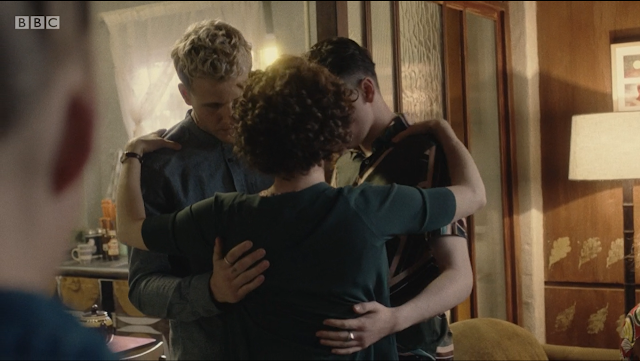
The wordless acceptance of an embrace from Jasmine signals that Meggie is willing to forgive her.

Her name is Ananya – it’s not that hard to pronounce!

I love how Noughts + Crosses does not limit itself to depicting overt racism, but also addresses the subtle behaviours people exhibit to constantly make a group different to them feel “other”. Jasmine’s failure to correctly grasp how to pronounce Ryan’s advocate’s name is an example. Interestingly, Ananya is neither a Nought nor a Cross – she appears to be of what we would call, Asian descent – but what is she in the world of Noughts + Crosses? We are never told.

Jasmine pays for one of the best defence lawyers in Albion to represent Ryan.

Noughts + Crosses outdoes itself in the costume design. Here Segun Okoro wears a traditional Yoruba agbada as his court suit, and a fila atop his head.

Ryan’s lawyer is a welcome break from the bigoted Crosses we have seen so much of already. He prepares the reporters for the hearing about to take place by characterising "an entire people, traduced and victimised on a daily basis".

The stage is set.  And the McGregors rise to the challenge.

The Noughts speak, and the Crosses listen.

There are audible gasps when Callum reveals that he has been stopped by the police “maybe, three hundred times” – despite having no criminal record. Never charged, but “stopped and searched, asked where I was going, who I was going to see… And sometimes they make me sit in a police car whilst they radio into the station, to see if I’m wanted for anything.”


Imagine having a judge in gele in real life: how cool would that be?!

When Ryan takes to the stand, his words too, are powerful. 

“[I felt anger] when my cousin was beaten up so badly by the police, he was paralysed from the waist down. Or when the girl I went to school with was raped by her Cross manager and then took her own life when she was told that no charges would be brought”, 

he tells us.

“Every Nought in there, they won’t have one of those stories, they’ll have twenty”, he adds.

He reminds Crosses that they are part of these stories, too – they are the ones who perpetuate the cycle. This scene hits close to home for any black person, and any person of colour, for whom racism is not TV fiction, but daily reality.

Jack Dorn’s not the only opportunist in this episode…

Callum, Meggie and Jude sit nervously as they wait for the judge’s verdict.

Who wears a sleeveless dress to a final court hearing? It’s not a wedding, Sephy!

After the verdict


I’m not going to tell you any more of what happens in episode 4. I’m just going to tell you to watch it for yourself. 

All six episodes of Noughts + Crosses are available to watch on BBC iPlayer and various other streaming services outside of the UK. Go and watch it! I've tried not to give away any key spoilers!


If you would like to do something to help Jacob Blake, mentioned earlier in this article, please sign this petition.

Thursday, 7 May 2015

Social justice ~ Socialist.


The most famous and widely-read book in the world has amongst its many wisdom-filled lines: ‘The love of money is the root of all evil’. Some would say that the Bible is outdated and doesn’t fit our modern-day society but I would say that it is still relevant, thousands of years after its writers first penned the words that fill its pages. For even that one assertion has plenty of evidence to prove it valid: yes, still in the 21st century.

I never used to be interested in politics. I saw it as boring and the concern of middle-aged men. But one sentence I heard uttered some time ago by a guest speaker on a radio programme changed my position. She said: “Women often say they’re not interested in politics. But the fact is, they want change. And that’s what politics is all about; it’s about seeking to change things for the better.” Her words struck me. They made me realise that I have actually been political since I was in primary school. I have always spoken my mind on matters that I believe to be indicators of societal problems and I have always sought to do what I can to change things. You already know that: you’re reading a blog post on The Change Channel.

As a child for whom the extent of political knowledge was the Prime Minister’s name, I remember once asking my mum what the job of the Conservatives was. Voting Labour is the the generally accepted thing to do around where I live, so I didn’t know much about ‘the other side’. She told me in simple terms: “the Conservatives are all about conserving things, keeping things the way they are.” She added half-in-jest: “They just want to keep all the money to themselves.”

It may have been a very simplistic explanation but even now I still think it’s an accurate description of the Conservative party. That is, the principal right-wing party in the UK. Now I’m not about to launch into eulogising Ed Milliband or begin a discussion on the rubberiness of his voice. Instead I’m going to tell you why I think a socialist approach goes hand in hand with social justice.

What is social justice?

Social justice is generally agreed to be ‘justice in terms of the distribution of wealth, opportunities, and privileges within a society’. Thomas Jefferson’s world-famous lines assert “that all men are created equal; that they are endowed by their Creator with certain unalienable rights; that among these are life, liberty, and the pursuit of happiness.” So if we were all born equal, what happened in between?

It’s self-evident that there are multiple inequalities in the world in which we live today. They can be found between men and women, the rich and the poor, whites and non-whites, the sheltered and the neglected, the able-bodied and the disabled . . . Social justice aspires to rid the world of these wrongs with the aim of bringing about a better, fairer world.  

And the place to start is acknowledging that some groups in society are dealt a better hand than others from the start. So we may all have been “created equal”, but the minute we enter a very unequal world, we are either ushered up to the top of the pile or shoved to the bottom, according to who society deems laudable or undeserving. The words of Rousseau come to mind: ‘Man is born free, and everywhere he is in chains’.

Capitalism

As I’ve grown older I’ve come to realise just how much the way our society is run is dependent on who’s got the largest amount of money (or who’s got hardly any of it). The fact is, money is power. So if you “ain’t” got much of it, you “ain’t” got much power. Capitalism as a system is characterised by the private ownership of the means of production (the raw materials and the labour force), and inevitably results in the unequal distribution of wealth. As its name suggests, it centres on capital (wealth), unlike its counterpart ideology: socialism, which radically places society at its focus, pushing for a society in which wealth is evenly distributed and is owned by a collective community, usually through the state. I studied Marxism as part of my Sociology course at Advanced Level and although the principles its founders propounded seemed interesting to me at the time, I never really fully realised the import of their ideological approaches until I came to uni. It was here that I saw Max Weber’s theories acted out in real life.

In simplistic terms, the model which Marxists created saw society as divided along class lines, the working class (the proletariat) and the upper classes (the bourgeoisie); staying in tune with a system intended to keep the labour workforce in their place – working hard for the richer people. Provided the proletariat stayed in their place, other institutions, like the media and education could flourish effectively. Flourish effectively for one group of people that is. Yep, you guessed it: for the rich dudes (the bourgeoisie folk). Very simplistic illustration but that’s basically how capitalism works – there are people on top who push others beneath them and make them do all the work so that they the rich people at the top – can have a good life: whilst the people breaking their backs get very little or nothing in return.

Doesn’t sound very fair to me! How about you? Not really the right conditions for social justice, I would say: makes for unequal  distribution of wealth, opportunities and privileges in a society. Want me to give you a few examples?

Women

OK so let’s look at the position of women in society. I’m sure you’ll agree that even in the 21st century a massive amount of inequality exists between men and women. Women make up 51% of the global population but worldwide figures show us that women are less likely than men to get an education, be employed or be elected to parliament – all the while they are more likely to be victims of domestic abuse, sexual assault, rape; more likely to be victims of sex trafficking; forced to be child brides – and worse still, some will deny females their right to live before they are even born, based on the lie that they have nothing good to offer the world.

Pretty horrible state of affairs.

You might be wondering what all this has to do with ‘the love of money’ that I referred to earlier, and the Marxist model and all of that. Allow me to explain my thought process: men have been the ones in positions of ultimate power for the past several centuries. In this modern age, women face fewer obstacles (although still many) to their endeavours than they once did, and so positions of power are no longer solely occupied by men.

It follows that some men feel threatened by the emergence of women in an arena in which they once found themselves alone. They resent that women will now have more of a say in their own lives, rather than having matters decided for them by those who want to “keep them in their place”. As things currently stand, in many cases women are still not paid the same amount of money as their male counterparts for the same work and they find themselves up against a ‘glass ceiling’ which prevents them from getting promoted in their fields because those positions are reserved for men.

How can we explain this if it not with capitalism? The more women get promoted, the fewer men get more cash in their pockets. Capitalism has a system to uphold and anything that shows any signs of messing with that status quo is soon stopped in its tracks. Think Jimmy Savile, that fishy so-called philanthropist who in actual fact used his powerful position to abuse thousands of young girls. Looking back on his life and the plethora of complaints made against Savile in his lifetime, it seems mind-boggling that something was not done earlier to change things.

But once I thought on things more deeply, I could see that it suited the interests of capitalism to leave a powerful man like Savile alone. The guy had been honoured by the Queen and was one of the most famous presenters on the TV: if he were to be charged, that would mean the end of high ratings for the BBC for Top of the Pops. If they got a man with that much power into trouble they would surely lose out on the power stakes themselves. People often have difficulty understanding why survivors of rape do not immediately report the crime: but in Savile’s case should it be so hard to believe? A rich white man loved by the British public against young teenage girls – who would be believed?

To my mind there is a clear link here between ‘the love of money’ and the evils sustained against women. Capitalism stacks the odds against those whose oppression it benefits from.

I’m not saying that capitalism is to blame for all the inequalities that women face today. However it is responsible for giving men more opportunities than women and it does grant the powerful safety nets which protect their interests, and this governs who ends up where. In spite of all this however, women continue to work hard and are still achieving great things. Despite being told they couldn’t do it, they are making their mark on science, sport, literature and many other fields. The thing is, it’s just so much harder for them to get there than it is for men. And that’s not fair.

Class

Capitalism presumes that the path to success is easy – because the path to success for those at the top of the capitalist ladder is easy. David Cameron (leader of the Conservative party) comes from a family which to this day is still benefiting from the ‘compensation’ they gained when they lost their slaves after the abolition. This sum, which equates to millions in today’s money, didn’t do Cameron any harm when he attended some of the highest fee-paying schools in the country.

The Conservatives, in their practice of capitalism, would tell us, ‘Work hard and you’ll get to where you want to in life.’ That’s their answer to everything. Work hard, that’s all well and good – but what if you have the attitude of a high-flyer yet are constantly having the opportunities which are your due right snatched away from you? That’s what happens if you’re a member of the lower classes – we see it everywhere.

Here at Oxford, where I’m studying, the evidence of classism is plain to see. It is with good reason that the university has a reputation of being a place for the cultural elite. Within the infrastructure and the intake of the students each year the upper classes most definitely come out on top. Studies in the past have shown that applicants from private schools were 14% more likely to be offered a place at Oxford than those with the same grades who went to a comprehensive school.  Although only 7% of British children attend fee-paying schools, students from private schools make up 43.2% of Oxford students! I mean, is that classist or what??

How can we say that where you get to in life is dependent on solely how hard you work when we have figures such as these staring us in the face? We all know that Oxbridge-educated people dominate the political sphere. David Cameron went to Brasenose College, Oxford, Ed Milliband went to Corpus Christi College, Oxford and Nick Clegg went to Cambridge (don’t expect me to give further details, we two universities are arch rivals!). I write from a college where the first and only female Prime Minister of the UK so far, Margaret Thatcher, and India’s first woman Prime Minister, Indira Ghandi, completed their degrees. 

So it’s evident that people that go to universities like these are more likely to have a say in the running of their countries. If they’re more likely to have a say in how the country is run they will be directly impacting on the lives of thousands, even millions, of people. And if only one small subsection of society is allowed to have a say in how people live their lives, how are things ever going to change?

We need a change from the bottom-up. The working classes and middle classes need to be given a say in how the country is run – because they make up over 70% of the nation. When less than 20% of the country is making the decisions that affect everyone then things are never going to be fair.

That means that universities like Oxford and Cambridge have a duty to accept more working class and middle class students than they currently are. The education system at large needs a massive overhaul to get the less well-off and the more deprived on the straits to success. At present those who live in poorer, more crime-filled areas, are less likely to get admitted into good schools. ‘Good schools’ being those who provide an adequate amount of teaching staff with decent sized classes so that each student is given the opportunity to learn properly. They are also more likely to be encouraged to take more vocational paths, being whispered the lie they are not skilled enough to go into the field of academics. And of course it is those who go into the academic field that end up having the most power in society. So the false consciousness to which the Marxists referred – the state of being that the working classes often find themselves in: where they are so accustomed to being exploited that they no longer question it and instead adopt the views of their oppressors – becomes instrumental in maintaining the status quo.

Many repeat that oft-used phrase: “They’re taking all our benefits!” to excuse the mistreatment of the working classes. But what they fail to realise is that the “scroungers” that sit on their bums all day and get paid by the state are very much in the minority: an unfortunate piece of the puzzle but very much in the minority. There are thousands of people in this country who work hard but find themselves displaced from the top-earning positions in the world of work (for reasons I have discussed above) and rather find themselves earning just enough to be out of the benefits cap but not enough to live comfortably. With childcare costs at a ridiculous high, many young families find themselves in debt before they have hardly gotten off the ground – and still they find themselves faced with that mantra: “Work hard and you’ll get where you want in life.”

It’s for people like this that I believe we need a re-structuring of wealth distribution. The richest 10% of the UK population owns something like 40% of the wealth. That’s just not fair – especially when those at the top largely didn’t work for what they had, but were just born into it – whilst those at the bottom find themselves dealt an unappealing deck of cards.

Race

Equality of opportunity is important again when we consider the structural inequalities that result from divisions along racial lines. Racism just isn’t over. If you’ve read my post about racism and the role of ignorance, you’ll already be familiar with the advice that black parents are wont to give their children:  “Work twice as hard at everything you do, because it’s going to take twice as much effort for you to get as far as a white person”.

If the working classes are in the minority in Oxford then ethnic minorities are an even rarer find. Out of term-time I live in the highly ethnically diverse and multicultural city in the North of England known as Manchester. It’s a vibrant place of friendly faces. The contrast between Manchester and Oxford couldn’t really be more different – when I return to the city of Dreaming Spires it’s literally a game of ‘spot the black people’. I can remember when I told a friend that I had been admitted into this university. He said: “You’ll be the only black person there!”

Figures have shown that in years past, over 25% of white applicants to Oxford University were successful, with only 17.2% of ethnic minority applicants getting in. White applicants to Medicine were twice as likely to get a place as minority ethnic candidates, even when they had all obtained 3 A* grades. Institutional racism is very clear to see. Only 3.9% of Oxford’s professors are of a BME (black, minority ethnic) background, to talk less of the curriculum being fiercely Eurocentric. Oh and don’t forget, one of the world’s most notorious racists has a library and a scholarship in his name over here. (That would be Mr. Cecil Rhodes, the man behind the apartheid in South Africa.)

Thankfully I don’t go to one of those super elitist colleges in Oxford where I’d be the only black person there in 5 years, or the only person from the North of England in my year, or something ridiculous like that. Somerville College is one of the more open and diverse colleges, with the majority of students having attended state schools. (I’m also proud of it for being one of the first colleges in Oxford to cater for women.) However that hasn’t made me oblivious to the racism that unfolds here in this university on a daily basis. 
Every time I go to a debate at the Oxford Union I am genuinely astonished by just how oblivious some people are to the plight of others, and just how easily they can spew racist bigotry without batting an eyelid.

Equality of opportunity as far as race is concerned is imperative if we are to see true social justice take place in the nations of the world. Ethnic minorities find themselves more likely to be demonised by the police, more likely to find themselves out of work, less likely to get good housing, less likely to be believed when filing a crime complaint . . .

The status quo keeps the traditional owners of wealth and power at the top. They “keep us in our place” by telling us that we’re not good enough, not pretty enough, (here I explore the relation between capitalism and the “beauty industry”), not skilled enough.

Disability

Disabled people are a group I fear we don’t talk enough about. They’re often forgotten in discussions about discrimination and equality. They shouldn’t be: there are over 11 million people living in the UK with a long term illness, impairment or disability, meaning they often cannot work. The school of thought that puts society first says that everyone should have the same amount of wealth so that we can all lead fair lives even if we're born into difficult positions: those who are on the capitalist side will only make those who are hurting the hurt even more. (click here to read more about how disabled people are already unfairly treated under current law.) Not a very just system, I don’t think.


I’m a socialist because I believe in social justice: fairness and equality in society. And I think I’ve explained why I don’t think capitalism is the best model for this: ‘the love of money’ gets to people’s heads and makes them forget what humanity is all about. As a Christian, reminded of the importance of helping those less fortunate than myself, I wouldn’t feel comfortable doing anything other than supporting the side that puts society’s interests at heart. That’s a much better picture of society to strive for than the one that we currently have.