Translate

Friday, 10 July 2020

Noughts + Crosses: A Review of the 3rd episode of the popular BBC drama series

Rating: 3 stars ⭐⭐⭐

Before reading, make sure you watch the first and second episodes of Noughts + Crosses, and read my reviews of them (here and here)! The below review contains a few spoilers as to what has already happened so far in the series…

The third episode of Noughts + Crosses is my least favourite so far, although the show is most certainly a class act.

Perhaps one of the reasons I am less raving about this episode is that it makes fewer salient points about the dichotomy of the “superior” and subjugated. That is not to say that they are not present – but in this episode, it is interpersonal relationships that come to the fore, and less so structural relationships.

With that said, the very first few words we hear in this episode are uttered by a university lecturer, who boldly proclaims before his class that:
“When the Aprican settlers first came to Albion, they were faced with a country in chaos.”
Does that type of rhetoric seem in any way familiar to you?

“Settlers”. Settlers, or invaders? Plunderers? Looters? 

When we talk about Americans in the modern-day, we rarely speak of Native Americans. The standard of Americanness we most typically see represented is Caucasian. We do not speak of “European Americans”, but “Asian-American” and “African-American” are staple terms. Why is this? Because white Americans are seen to be the standard. Those with a greater right to be there than anyone else. Settlers. The reality is that Christopher Columbus did not “discover” America, the indigenous peoples were already there. They were slaughtered and displaced from their land - and then the invaders called themselves “Americans”.

In the dystopian world of Noughts + Crosses, Apricans behave in much the same way. The Crosses determine themselves to be those with the right to be there. The Noughts are worse than an inconvenience to them.

The Crosses legitimise their dehumanisation of the Noughts by convincing themselves that they saved the Noughts from “their own worst tendencies”. They tell themselves that Albion was “a country in chaos” before the wonderful saviours arrived.

This mirrors the notion of the white saviour complex, visible in our world today. This complex can be found in literary writings: some of those I had to study at university would refer to “the civilised world” – by which they mean the white world. You can also spot the white saviour complex in short-term missionary trips where white Westerners clamour to take photos with little black children – excited to post them on their social media feeds once they return.

In an effort to make Crosses the heroes of the story, Sephy’s professor states, with no shame: 
“An ongoing, brutal civil war had left many of its [Albion’s] barbaric inhabitants dying of plague or starvation.”
“Barbaric”. No doubt we are used to seeing that word used in racist rhetoric, just to describe a different racial group.

Sephy has transformed the naïve, privileged Cross girl she was when we first met her. Now, she challenges her professor with no shame.


She does get in trouble for it, though. But with the Home Secretary as her father, she doesn’t pay too hefty a price.

Not that Kamal Hadley, Sephy’s father, appreciates her moral commitment to equality for Noughts. He gets a bee in his bonnet when it is announced that Noughts will for the first time ever, be allowed to publicly celebrate their traditional festival, Midsummer. He’s a bit pathetic.


Kamal has the same idea in his head that the inventors of classical racism had: that one race is intrinsically superior, and other races are inherently inferior – and thus equality is not the modus operandi.

In this world of systemic oppression, it is difficult for Noughts to occupy much space.

When Ryan, Callum’s father, struggles to find a new job, his son Jude asks:


Though only afforded a few lines in the script, this point is striking. In the reality of our world, in white-majority countries such as the UK, “foreign-sounding” names have been proven to make the lives of those who carry them more difficult. It is more difficult for someone with a “non-English-sounding name” to get an interview or sometimes a place on an educational course. In this dystopian world, the Noughts are the group who are systematically denied a place at the table.

The Complexity of Interpersonal Relationships

The love story between Callum and Sephy continues to be spun in this episode.

Relationships take centre stage in this episode. Not just the romance between Sephy and Callum – we see a number of interpersonal relationships fractured by friction in episode three.


The friendship between Jasmine (Sephy’s mother) and Meggie (Callum’s mother) is one of them. We see Jasmine descend into alcohol addiction and deep depression. In her hurt, she pushes her long-time employee and friend, Meggie, away – and into the shadows. 

Jasmine develops a dependency on the bottle
A stunned Meggie stands in shock after Jasmine deals her an unexpected blow
As conflict divides their mothers, Sephy and Callum too, are faced with a divide. A divide of a different nature. Notwithstanding their love for each other, the state-imposed separation of Noughts and Crosses continues to complicate the young couple’s relationship.

Callum is questioned by an officer simply for standing by Sephy in front of Danny’s memorial.
 Just as many black people are racially profiled as “suspicious”, Callum is interrogated by an officer simply because he is standing with a Cross woman – and in a district different to the one in which he lives. Reminds me of the video that surfaced a few weeks back of a white police officer stopping a black man, here in the UK, using the words “No offence to you, but you’re a black male” and “I haven’t seen you before” – thereby arriving at the conclusion that the driver must be a drug dealer.

Mirroring the racial profiling Callum is subjected to, the presumption that Noughts = trouble is the driving force for the tank that shows up at the Midsummer festival. 

The Noughts’ version of a Caribbean carnival! They look pretty harmless to me…
… But unbelievably, a military tank is deployed to police the crowds.
Racial stereotyping is evident in Jasmine’s rhetoric, too. In her attempt to urge Sephy not to attend the Midsummer festival, she lets slip some shocking hypocrisy.


Jasmine isn't exactly teetotal herself...

Expectations for women are the same in this world.

As the rift widens between Jasmine and Sephy, we see another interpersonal relationship further disintegrate: Callum and Jude’s. What happens to Callum’s brother is what often happens to a group of marginalised, disenfranchised people. Jude feels a desperate need to belong – and goes searching for his identity in the wrong place. I don’t know about you, but I actually feel pity for him.  

Jude seems to seek approval from Jack Dorn in the way one might seek approval from a father.

This episode sees Jude and Callum pitted against each other in a way we have never seen before.


Lekan, Sephy’s now ex-boyfriend, has a part to play in that. He pulls a ruse that nearly costs Jude his life. Realising that Mercy Point will never truly be for him and his people, Callum decides to walk away.


In the chaos of their divided world, Callum and Sephy find comfort and solace in each other.

A bit too much comfort and solace, if you know what I mean.

As they are doing the deed (not shown, thankfully), Meggie bumps into someone on her way home who personifies the ghosts of Kamal’s past. Yaro. Yaro is played by Luke Bailey. Sorry to say, but Bailey is the worst actor in an otherwise pretty stellar cast. I don’t know what accent he is supposed to be speaking in, but if it is meant to be a Nigerian accent, it isn’t a very good one. 


Yaro and Meggie’s exchange doesn’t last long. Then comes the awkward and laughable moment in which Meggie finds her son and Sephy upstairs. The contrast between this moment and the one shown in the still below, is striking.
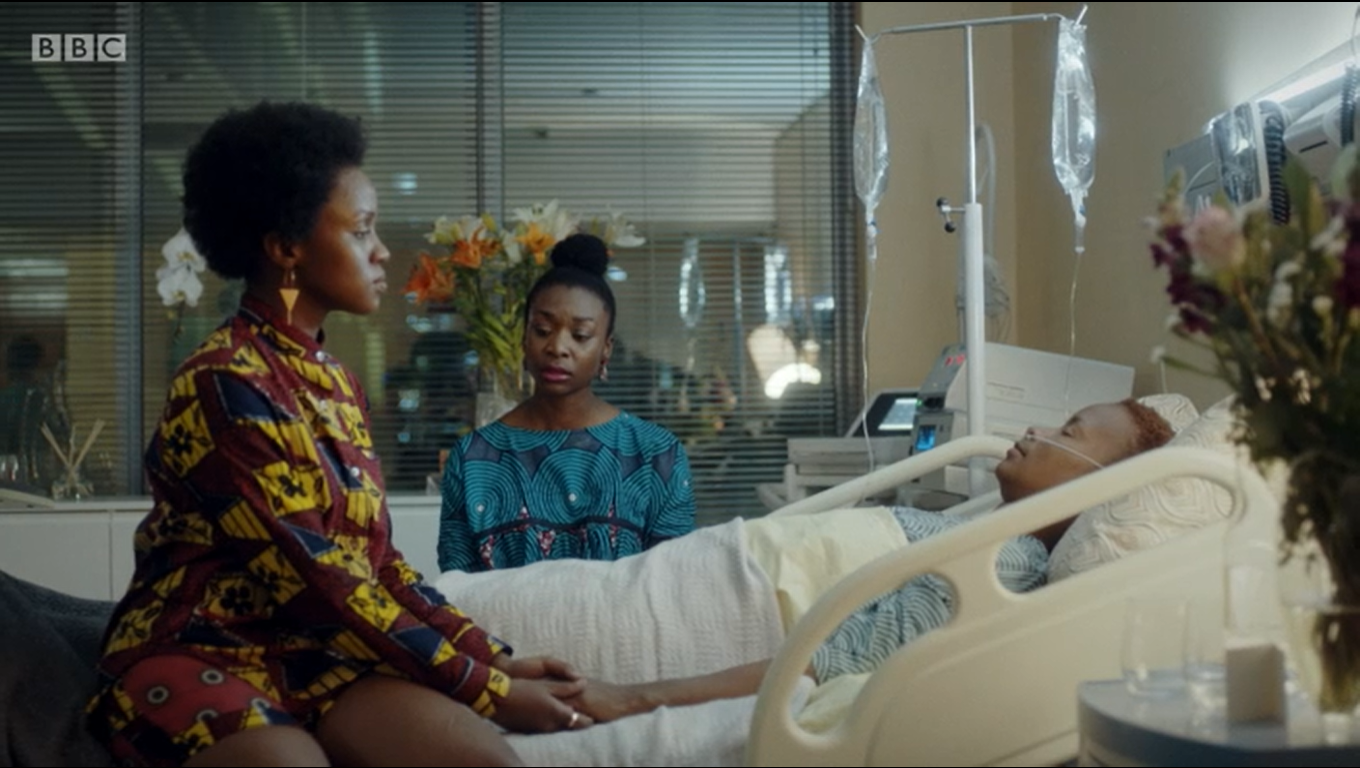

Jasmine’s hospitalisation brings into focus the importance of family. It causes Sephy, her sister Minerva and their father Kamal, to reassess their priorities.

Meanwhile, trouble begins to set on Jude and Callum’s relationship. Jude is less than impressed when he learns that Callum and Sephy are seeing each other.


Some might say the same about Callum! ;)
Callum’s reaction to a drastic decision that Jude has made, on the other hand, provokes a much more volatile response. The directions the two have decided to take in response to racial injustice are diametrically opposed.

Let’s just say, this episode is full of drama.

Watch it.

All six episodes of Noughts + Crosses are available to watch on BBC iPlayer and various other streaming services outside of the UK. Go and watch it! I've tried not to give away any key spoilers!

Tuesday, 9 June 2020

Noughts + Crosses: A Review of the 2nd episode of the popular BBC drama series

Rating: 4.5 stars ⭐⭐⭐⭐ (I can't find a half-star!)

Before reading, make sure you watch the first episode of Noughts + Crosses, and read my review of it! The below review contains a few spoilers as to what happened in episode 1…

Noughts + Crosses pulls no punches. Right from the beginning of this episode, just as in the pilot, we are uncomfortably dragged into a world where the tides of anger never ebb. In this episode, we see Callum take his place at Mercy Point, the military school into which he has been accepted. He is very much in the minority: this is the first year that Mercy Point has desegregated and allowed both Crosses and Noughts to enrol. The commanding officers there won’t let Callum and the other Noughts forget that their presence is unwelcome.

This is the type of aggression that Callum regularly has to deal with.

Let’s just take a minute to appreciate the title sequence which appears in every episode of Noughts + Crosses. Accompanied by impressive music, black and white skin melds together, a visual demonstration that opposites can attract and beautifully harmonise together, just as both the black and white keys on a piano produce scintillating chords.


The title sequence depicts the idealistic version of relationships between Noughts and Crosses. In the dystopian reality of Albion, Sephy and Callum – and any others that represent a fusion between these two dichotomic worlds, are forever at war with the system. Peace can never be theirs.

Once the title sequence is over, the charged voice of Jack Dorn, leader of the Liberation Militia, carries over to us. In stark contrast to the fury in his voice, we are presented with the stunning landscape of Albion. The dominant figure of a black woman with her head swathed in a headtie reminds us that we are in a world in which Aprican (inspired by ‘African’) culture reigns. It is worth noting that traditionally, many Sub-Saharan African traditions celebrate the mother figure. This attention to detail is impressive. Set designer Karl du Preez does a marvellous job, if you ask me! (Interesting fact: the show was actually filmed in South Africa.)

This is London as you’ve never seen it before.
The words of Jack Dorn are potent and pertinent to the reality we find ourselves facing today:
“The establishment and its Aprican masters showing more distress over the destruction of Cross property than the death of a young Nought man.”
Sound familiar?

Superb Social Commentary


Sephy is less naïve in this episode than she was in the first. She takes the courageous step of pointing out to her father, the Home Secretary, that one set of rules apply to Noughts, and another to Crosses. When Noughts gather together peacefully and “try to exercise [their] right [to speak freely], the riot police show up.” The same is not so for the ruling race.

Callum can’t even sleep on his own mattress at the military academy: the Crosses there soak it in wee. This type of overt and nasty racism exists alongside regular micro-aggressions, such as the one that Callum’s friend Elaine receives from the idiot (excuse my language) that is Lekan:
“So Elaine… is it true? Nought women in bed? People say you’re pretty crazy.”
Noughts + Crosses doesn’t just tackle racism. It makes room for other complex societal ills in its storytelling. The above quote is an example of how the show recognises and addresses intersectionality: when racism and sexism intersect, the discrimination factor is squared.

Racism is evident in almost every shot in this show. In the scene where Sephy Hadley and her family travel to Mercy Point’s passing-in parade, several Crosses surround their car with placards emblazoned with the words “NOUGHTS OUT”. Sephy and Callum’s father Ryan are forced to halt their pleasant catch-up as they arrive at the entrance: there is one entryway for Crosses and another for Noughts. Ryan is forced to undergo a security check, as are all the other Noughts, and Sephy is left to walk freely. Remind you of anything? Disproportionate stop-and-search rates, anyone?

Once the parade begins, we hear the rhythmic beat of the talking drum echo through the air. The talking drum originates from West Africa and comes in many various forms.


What a stunning plethora of colourful traditional outfits!
The call and response of the commanding officer to his soldiers sounds a lot like Yoruba.
Let’s talk about hair.


Noughts + Crosses does not leave any stone unturned! Black hair is a topic in itself. Historically and in the present day, the tightly-curled tresses of people of African descent has been shamed, called 'ugly', 'untameable', 'unprofessional'… Meanwhile, silky European hair has been overvalued and presented as the standard of beauty to follow. As a result, many businesses have profited off creating products which claim to 'subdue'natural Afro hair so that women in particular, may better assimilate into society and better meet the prescribed beauty standard. Of course, in Noughts + Crosses, our present-day reality is turned upside down! See how both the Nought men and women wear traditionally African braided styles? Not a coincidence!

“We must be careful not to become too homogenised”, says Kamal Hadley, Sephy’s father, as he delivers the address. Protect your identity”, he utters, painstakingly enunciating each word so we clearly understand his meaning: Do not mix with these Noughts too much, Crosses.

The words “E se gan” – ‘Thank you very much’ in Yoruba, ring out from the stage. Once again, I must say that it would be nice to have other African languages depicted in this show. Nigeria is one country in Africa’s vast landscape, and Yoruba is just one of many languages native to Nigeria. Perhaps the bias is owing to the writer of the show, Lydia Adetunji, who has Nigerian – and specifically Yoruba – heritage.

It is around this time that the triangle between Lekan (Sephy’s boyfriend), Sephy and Callum begins to trace its lines. 

There is no doubt that in this triangle, it is Callum that has the most to lose. Despite her position, Sephy is bold (though surreptitious) with her attentions to Callum. Callum is much more cautious.

Lekan detests Callum and all Noughts, and he is not afraid to show it.

The racial stereotypes that he holds are evident: “Must be nice to get two whole days for getting drunk on street corners, playing with wild Nought women”, he tauntingly shouts at Callum, before being told that Callum’s weekend off is due to his friend’s funeral…

Interestingly enough, although Home Secretary Kamal Hadley (played by Paterson Joseph) is vitriolically racist, the Prime Minister, Opal Folami is reasonable. She calls for an independent enquiry into police brutality. Independent. The police are not called on to investigate its own misconduct, but instead are to be assessed by an outside body. Remind you of anything that should be happening in real life right now?

Although the Prime Minister of the nation, as a female, Opal Folami, too, is subjected to sexism. The men that work under her rarely heed her.

The dysfunction of male-female relationships is most evident between Lekan and Sephy, however. Lekan truly shows all the signs of a future domestic abuser. He is controlling, manipulative and paranoid. His behaviour in this episode is alarming.

In this episode, for the first time we learn something about other races in Albion, although I would contend, not enough. There is not much clarity as to the position and treatment of races that are neither Noughts nor Crosses. Callum’s father Ryan has a boss who appears to be mixed-race. Okonjo is such a totalitarian manager that he refuses Danny’s father the day off for his own son’s funeral. When Ryan confronts Okonjo, he says in disbelief to his boss: “…You’re one of us!”


This is interesting. This one line is comparable to the way in which often, when someone is of both black and white heritage, they are typically considered 'black', even though they also have 50% white heritage. (America has never had a 'black' President, they have had a 'mixed-race' one.) They are typically more accepted by the black community than the white community.

Thus, perhaps Ryan is suggesting that it is Noughts who will truly accept Okonjo, as he is of mixed heritage? Okonjo’s response indicates that he has become accepted by the Crosses only because of his financial status, and that if he associates on more friendly terms with Noughts, he will lose his position. Indeed, it seems he has come to a place of denying part of his own identity in order to fit in and be respected. Many people of colour can relate to this. The culture of assimilation. Assimilation often comes with self-denigration.

Conversely, Callum and Sephy refuse to comply with social expectations, even knowing what it could cost them. Tired of having to hide their affection for each other, they decide to go to a clandestine club for interracial couples. [You need to watch the episode; I’m not telling you everything that happens.]

The chemistry between Sephy and Callum is masterful. Both Masali Baduza and Jack Rowan do an amazing job. The pauses, the intensity of their eyes, the shyness of two young people in love… The director Julian Holmes creates a heart-warming story that becomes all the more heart-warming precisely because the two parties are prepared to risk everything just so they can be together. Reminds me of the story of Mr. and Mrs. Loving, a real-life interracial couple who decided to be together, despite interracial romances being illegal at that time in America.

Sephy and Callum, finally free to dance to their own tune
However, we soon learn that Shakespeare’s words ring true here, too: “the course of true love never did run smooth”.

I told you Lekan was paranoid…

The wrath of Lekan is truly a frightening thing.

You need to watch this episode.

Let’s just say the triangle gets a little more complicated as the minutes pass. Sephy begins to realise that this love thing isn’t going to be as easy as she thought.


The drama that takes place in that club is contrasted by the stillness of Danny’s funeral, a few minutes later. The ritual of Danny’s interment is much like Egyptian mummification, which of course is jarring to us today. The startling reminder that even burial customs are different for Noughts, forces us to consider how many customs we take for granted today are actually products of the West, yet have been taken on by colonised people globally.


In this episode, we see just how power-hungry Kamal Hadley is. The Home Secretary decides to strike a deal with Liberation Militia leader Jack Dorn, in an effort to both appease the Noughts and dismantle the Prime Minister’s leadership. Dorn is wary though. He knows that the plan is to give the Noughts:
“just enough rights to keep us docile. Just enough liberty to take away our rage.”
This line is unforgettable: “Would you be happy being ‘almost’ completely equal to me?” Dorn asks the Home Secretary. Hadley’s silence reminds me of the scene in which white anti-racism activist Jane Elliott says to a crowd of white people, “If you as a white person would be happy to receive the same treatment that our black citizens do in our society, please stand.” No-one stands.

Sephy: a woman with a mind of her own


Believe it or not, in this episode, Sephy finally sees the light. She cuts ties with Lekan.

The guy is so narcissistic, he tells her that she can’t break up with him, for apparently: “We don’t do this.” Reminds me of Mr. Collins in Pride and Prejudice: he just doesn’t seem to understand the meaning of the word “no”. 


Well, that's what I call a clapback.


It seems one set of rules apply to men, and another to women. Oh, wait, that isn’t just a Noughts + Crosses thing...

This episode is an intriguing follow-up to the pilot episode, and excels in its character development, storytelling, set design and social commentary. Watch it.

All six episodes of Noughts + Crosses are available to watch on BBC iPlayer and various other streaming services outside of the UK. What are you waiting for?


Thursday, 28 May 2020

Noughts + Crosses: A Review of the 1st episode of the popular BBC drama series

Rating: 4.5 stars ⭐⭐⭐⭐ (I can't find a half-star!)


Malorie Blackman’s dystopian world vividly comes to life this year on our screens through the BBC drama adaptation Noughts + Crosses. The TV show takes its name from the first novel in Blackman’s critically-acclaimed series, which debuted in 2001 and has a new book yet to enter into its fold. Blackman’s creation was innovative in 2001 and even in 2020, it is mind-blowing.

Noughts + Crosses is set in Aprica, a fictional creation of Blackman’s, inspired by the real Africa. Aprica is like an African transposition of the United Kingdom, where the sounds and sights of heterogeneous African culture intermingle with the familiarity of London accents. What is impressive about both Blackman’s creation and the BBC show’s adaptation of it, is how our current reality is flipped on its head. Where in reality Africa was the colonised continent, Aprica is the coloniser. Where Europeans have in actual history been the invaders, in Noughts + Crosses, they are the invaded.

The first episode of Noughts + Crosses informs us that Apricans invaded Europe over 700 years before we begin the story. In this dystopian world, the Crosses are the black people and wield the power to oppress the colonised white people, known as Noughts. 


The protagonists of this tale are Callum (played by Jack Rowan) and Sephy (Masali Baduza). Callum is a Nought who lives in a rundown area of London, whereas Sephy is the privileged Cross daughter of the Home Secretary and lives in a mansion where Nought servants pick her clothes up off the floor.

The parallels between today’s reality and this fictional universe are striking. Language is important, as we all know, in establishing notions of superiority and inferiority. Thus, the oppressed race being called “Noughts” is not an oversight. They are treated as nothing.

Meanwhile, the term for the opposite race, “Crosses”, may even call to mind the image of the crucifix. They are deemed superior, cleaner and more worthy than the “Noughts”. Similarly, “black” and “white” as racial terms have long been used to justify deeming black people “dirty”, “godless” and “impure”, whilst white is seen as “pure”, “holy” and “superior”. The BBC show further reiterates the mastermind vocabulary of Blackman by featuring the words “blanker” and “dagger” repeatedly. “Blanker” is the Noughts + Crosses equivalent of the racial slur “nigger”, whilst “dagger” is comparative to “white trash”. But remember: the colours are swapped around in this world!

Malorie Blackman’s magicking up of Callum and Sephy was a reaction to racism of the 1990s. The Stephen Lawrence case (where a 19-year old black male was the victim of a racist murder) was still fresh. In 2020, although things have changed, much is still the same. Perhaps even worse, in some ways. I write this hours after learning of the modern-day lynching of black American George Floyd in the street, a white police officer crushing Floyd’s neck with his knee.

Noughts + Crosses is not shy. It is bold, fierce and daring. And I find it to be a brilliant, enlightening and effective portrayal of the evil of racism.

We have barely broken one minute when we see police brutality take centre stage. Callum and his brother Jude are at a party with his friends, when they hear the ominous sirens of the police. The crowd immediately scatters, fear in the eyes of each of the Noughts present. Unfortunately for Callum, Jude (Josh Dylan) and their friend Danny (Charles Jones), the police catch sight of them in an alleyway.

Their bodies immediately slump into subservience. They know that meetings with the police do not typically end well for those with their complexion.

Before they know it, the police are pushing them against a van – all except Jude, who tries to be the smart one and contest his rights. That approach doesn’t work; instead it riles up the officers all the more – and Danny is violently knocked to the ground, blood streaming from his head.

Danny with his hands on the police van, moments before he is struck in the head


This may be fiction but it mirrors the reality of the present day. Black people know not to try and argue with the police, because it could end very badly for them. Think of Sandra Bland. This reality is not limited to America. Black people are disproportionately stopped and searched by officers in the UK, and are sometimes the subject of police brutality. Although I am grateful for the police, I still feel a tightening in my chest every time I am driving and a police car nears. I remember being in the car once and my mum being forced to stop by a white police officer, who made preposterous claims about the way she was driving. We both knew that the only reason she was stopped is because she is black.

This intense scene in the first episode of N+C mirrors today’s news in many ways. The unprovoked attack on Danny is caught on video by surrounding Noughts, who have returned and begin to shout at the police officers. Danny is rushed to the hospital, where he fights for his life.

Let’s be honest: in today’s society, when black people are violently attacked by white police officers, they rarely survive long enough to get to hospital.

The paradox in the lives of Noughts and Crosses quickly becomes apparent. While Callum sadly awaits news of his friend Danny, Sephy excitedly prepares for her mother Jasmine’s birthday party, completely oblivious to the news on the T.V. directly before her, retelling the attack. Her ability to zone this out struck me. She has the privilege of existing in a world where racism will never directly affect her; therefore she can develop the ability to zone it out. What a privilege.

The BBC series does a fantastic job of representing the rich and diverse cultures of Africa. Yet one of my few criticisms of the show is that it zooms in too much on the national culture of one actual nation in particular. The culture of Nigeria is overrepresented, to the detriment of many other notable African cultures. And I say this as someone of Nigerian heritage. This said, it is something quite spectacular to see the beauty of Nigerian culture celebrated on my TV screen: something I have never seen on British television.

Sephy and her sister Minerva sing birthday celebrations to their mother in Yoruba (incidentally, this is the tribe my family draws its roots from), a Nigerian tribal language. Notice the traditional African print on their clothing. 

Today, let us dance

It is interesting to note that the McGregor family (Callum’s household) also wear traditional African clothing. Callum's mother Meggie (played by Helen Baxendale, who you might recognise as Emily from Friends), wears an African-inspired dress and Callum, a patterned shirt in the below still. Jude and Callum’s father’s rejection of this clothing mirrors their outlook of being more subversive and unwilling to assimilate into the culture of their oppressors.


Jude’s response to the attack on his friend Danny is to become angry. He decides to meet with an anti-racist force known as the Liberation Militia. Though Callum, too, is hurt, his hope of change is to qualify for a place at military academy Mercy Point, where he will be able to prove the Crosses and their stereotypes wrong.

As Callum walks to the home of Home Secretary Kamal Hadley, where his mother has convinced him to serve as a waiter at Jasmine’s party, it becomes apparent how quickly the Cross media have twisted the facts of the attack to suit their own agenda. Callum walks past a billboard bearing the headline “POLICE ATTACKED IN CONTINUED NOUGHT VIOLENCE”, and moments later he sees a nought being cruelly bundled into the back of a police van. The parallels between this and our current-day reality are explicit. Every time another unarmed black person is senselessly killed, the narrative very quickly becomes “He [the victim] was dangerous. They [the attackers] were only protecting themselves.”

Kamal Hadley, Sephy’s father, is one of those who pushes this propaganda. In an encouraging display of what can happen when the privileged care for the downtrodden, the female Prime Minister of Albion does not back him.

Take a moment to admire the Kente cloth outfit worn by the Prime Minister in this shot. Kente cloth is a fabric native to Ghana. The headdress the Prime Minister is wearing is known as a gele, a Nigerian head-tie worn by women at special occasions. Even her necklace is traditionally African. Doesn’t she look amazing?!


Noughts + Crosses outdoes itself in both the great and small details. The disproportionate unemployment faced by Noughts is brought to our attention; a bunch of them coming to the docks every day hoping for a job. The blown-up face of a Cross woman with beaded hair on a gigantic billboard reminds us that in this world, black (Cross) is the beauty standard. As Callum’s mother Meggie travels on the bus, the camera cuts to a sign forbidding romantic relationships between Noughts and Crosses.

Think of slavery, colonisation, apartheid and the Jim Crow laws. Then imagine a society in which all of them have existed. That is Albion. Here, the Crosses reign.

It is so atypical to see blackness celebrated on screen that it is something strangely wonderful to hear traditional African music as the soundtrack of this show. At Sephy’s mother’s party, the band breaks out into a groovy tune in one of the Songhoi dialects of Mali. 

Jasmine’s party is a cocktail of rich sights and sounds. As well as the traditional prints and clothing pieces, the women proudly wear their hair in its natural texture. The Aprican culture is celebrated.
Callum immediately notices when Sephy enters the party. (Still above.) He is blown away by her beauty, yet they are from opposite worlds, and her world does not make room for people like him. We see Callum watch the Hadleys and their Cross guests revelling; he and other Noughts present but not invited to the party. Angered by Kamal Hadley’s apathy to the plight of the Noughts, Callum breaks a glass and cuts his finger.

This is where Callum and Sephy finally meet. Sephy goes looking for Callum, and we discover that these two actually grew up together as children. Much has since changed. Sephy helps Callum bandage his finger, only to awkwardly pause as they both realise that the plaster is designed for brown skin, not skin like Callum’s. (That is so clever!)

This episode exposes us to Sephy’s ignorance. She is so naïve! A key example is the scene below. Callum doesn’t feel the need to spell out the link between his friend being in hospital and the police, as Noughts are so often attacked by the police. Sephy hasn’t got a clue.


Later in the episode, Callum attends the vigil where people gather to mourn and pray for his friend Danny outside the hospital. Sephy arrives and is met with a combination of warmth and hostility by the Noughts. Callum can’t believe she has come. Before they know it, their peaceful gathering is scattered by the onslaught of police, who shout that this is an “illegal protest”.

Callum and Sephy escape to the hospital, where Sephy is able to use her Cross privilege to get the parents into Danny’s hospital room, which they were previously barred from entering. As they walk home, Callum and Sephy are attacked by a group of Noughts, who are angry with Callum for associating with a Cross. Callum is viciously beaten, and Sephy roughly held back, until she screams at one of the guys, “Get off me, you Blanker!”

In that moment, the infighting between the Noughts comes to an abrupt end. In that moment, they all are one. They are all the same to Sephy: as Noughts, the word “Blanker” is a derogatory slur used against all of them.

A deafening silence ensues, broken only by the pathetic apologies of Sephy. A police officer arrives, and because of Sephy and only because of her, all the Noughts are left to walk free. The betrayal is painfully etched across Callum’s face as he walks away.

The episode most certainly does not end there.  There is much more to this episode than the little I have fleshed out here. I’ll leave you with this quote from Sephy: 
“I’d love to pretend that I’m not like the other Crosses; that I’m better than that – but I’m not! I just didn’t want to realise it.”

All six episodes of Noughts + Crosses are available to watch on BBC iPlayer and various other streaming services outside of the UK. Go and watch it! I've tried not to give away any key spoilers!


Saturday, 2 May 2020

Get Over Yourself.

Get over yourself.


People have been saying that the coronavirus is the great equaliser. To some extent, they are right. Covid-19 has affected our whole world: rich and poor; young and old; educated and non-educated; those in good health, those in poor health; men and women; white, brown, black…

However, not everyone has been affected to the same extent. Let’s make no bones about it.

I think finally, some people that wanted to pretend inequality does not exist, are waking up to smell the coffee.

This post is not intended to make you comfortable. Get over yourself.

Oh don’t worry, that phrase – which you are going to see again and again as your eyes follow the trail of these words – is one I have used for myself, too - and continue to check myself with. I am not picking on you.

The fact is, most of us live with some kind of privilege.

It is comfortable to be privileged.


As a black Christian woman who lives with a long-term condition and speaks with a Northern accent, I’ll admit that I’m not usually the most privileged person in the room.

However, I do live with privilege. I am from a middle-class home. I have never spent a night on the street. I have never had to worry about whether or not I could afford pads for my monthly cycle. I went to good schools throughout my life, and then went to one of the top universities in the world.

None of this is my fault, nor am I ashamed of it. But it would be stupid to start an argument with someone that has known a life of being homeless by stating, “Well, I used to tour with a Christian drama company, and sometimes we didn’t even know if we would have a place to stay that night!”

Erm… That would be an extremely dumb thing to say, and would be utterly missing the point.

Likewise, it would also be incredibly foolish for me to say to someone who grew up on an estate where all the local schools were poorly funded and were filled with students unwilling to learn, that I know exactly how they feel “because I didn’t go to Eton, I went to a state grammar school”. 


If I said that, I would feel an overwhelming urge to slap myself in the face.

Privileged people are generally quite inept at seeing their own privilege. My guess is that it makes them feel uncomfortable. Recognising that they are at the top of the ladder leaves room for someone to topple them from the highest rung. It also means they might have to do something to turn the tables. And they don’t much like that idea. 

Actually, it’s not a guess. I KNOW that it makes us feel uncomfortable to see our own privilege.

I have a lot of amazing friends. And many of them are involved in social justice causes. I have a number of friends who champion the needs of the homeless. At university, many of my friends were involved in “homeless outreach”, where they would get up close and personal with people on the street, provide them with food and talk to them about Jesus.

I never got involved with homeless outreach. Not because I don’t care about the homeless, or sympathise with their plight. It was more because the idea of getting involved made me feel uncomfortable.

To be fair, I was involved with a huge amount of societies at Oxford and I generally needed some time to rest on a Friday. However, I could have gone just once. I never did.

Why? Because the idea of making friends with homeless people made me uncomfortable. I had given small amounts of cash to people before, and I came to realise they were almost certainly using-it for drugs. I also felt uncomfortable because I was a young 18/19-year-old woman and most of the homeless people I would be helping were older men.

However, in dwelling on these realities, I did not leave much room in my brain to consider the needs of these people. When we focus on our comfort, we often do not consider other people’s humanity. The first step in recognising privilege is recognising that we are all the same, in essence: therefore, none of us has a right to believe themselves any better than anyone else. The next natural step is to do something to give a leg up to those squashed by the status quo. Unfortunately, society rewards those higher up on the social ladder, meaning that this can be counterintuitive. 

We want a world of peace. However, peace can only reign where there is justice.

If one us is suffering, we all suffer.

Covid-19 is finally forcing us to realise this reality.

People are dying. I’m not interested in your comfort. 


If you know me, you’ll know that I get very angry about injustice.

The forms of injustice I see used as ammunition against people based on the very essence of who they are, get me the most het up.

Racism and sexism are some of the big ones.

I believe that every human being is made in the image of God. Therefore, when you treat another human being as less than – based on an attribute that is in their DNA – well, you are not just insulting them, you are insulting God.

Get over yourself.

I have friends of many different hues. I love it. I love that the colours of our skin are not a barrier in establishing meaningful and lasting connections.

I therefore have conversations with my friends about race fairly often. I don’t shy away from it. I most certainly do not apologise for talking about an injustice that is causing death to many, and ruining the lives of countless people.

Some of my white friends actually will begin these discussions themselves – they care about injustice, and therefore, racism is not off limits. They also LISTEN when I talk to them about my experiences, and enlighten them on elements of my culture that they may not know about.

Conversations with some of my other friends do not quite follow this pattern. I’ve found myself in conversations with white friends where they start CORRECTING me on racism. Better yet, some seem to think it doesn’t exist. Excuse me, but as a white person born and raised in a white-majority country, how do you really think you can invalidate my lived experience as a black woman who has lived in several white-majority countries?

It took all the grace of God and strength of Jesus for me to not say something VERY RUDE back to them. Instead, I would politely tell them that were completely wrong. 


I am fully aware of when people get uncomfortable about me bringing up racism in discussion. They do that thing where they shrink back in their seats and take an audible breath in, looking around as though they would rather be anywhere but THERE.

Ohh, I’m sorry, does this make you UNCOMFORTABLE??

Well, how do you think it feels to get pushed on the metro with people muttering horrible words about your skin tone? How do you think it feels to be beaten up on the street because you are black? How do you think it feels to be attacked on the street just because you are Chinese; people accusing you of bringing the coronavirus into the country? How do you think it feels to be KILLED just because you are a brown Muslim? Do you think that the thoughts of these people at the time they are attacked is, OH MY GOSH, I FEEL SO UNCOMFORTABLE RIGHT NOW?!


Get over yourself.

People of colour, don’t sit there looking so smug. Sometimes we need to get over ourselves too. You think black or brown people can’t be racist? So why is it possible that some of my family members might never speak to me again if I were to marry a white man? 

Some of you chocolate people only make friends with other chocolate bars. Why? Some of you spend a lot of time complaining about how awful white people are, yet you live in a country inhabited mostly by white people - because some white people gave you permanent residence. You had better get over yourself.

My melanin brothers and sisters, some of you are spending all of your energy getting worked up about white people wearing dreadlocks, when people are dying because they are black and brown. I think you need to pick your battles.


WE ALL NEED TO GET OVER OURSELVES.


If you feel uncomfortable as a man when a lady starts talking about how difficult it can be to be a woman, and how sexual harassment and assault is a common evil we learn to live with, you need to get over yourself. I know some amazing men who will actually listen, but I know of those who will immediately feel as though their masculinity is under attack – “Not all men do that!”

Did we say so?

Why don’t you try saying that to the woman who has been physically and mentally abused, raped and much more by a string of men in her lifetime? Are you really trying to tell me that toxic masculinity is not a thing?

Sure, you might not be a toxic male. I recognise that not all men are. Thankfully. However, to get offended when someone makes the point that toxic masculinity is a thing is completely missing the point.

Get over yourself.

I Got Over Myself.


Where I might have once been uncomfortable around homeless people, now when I see the homeless man that is a regular outside a nearby supermarket, I stop and talk with him. Sometimes I buy him food, if I have anything to spare. A few years ago, I would have given him a quick smile and rushed past, before he could ask me for anything. Now I know his name. Last time I saw him, I prayed for him.

What changed? I got over myself.

I recognised that the cause of the homeless was not solely the job of my friends, already doing a great job championing those on the streets. It was mine too.

It is not just MY (or any other black / brown person's) job to raise awareness about racism. Nor is it just Ruth’s (or any other woman's) responsibility to talk about sexism. Have you been thinking, Oh Ruth is an ambassador with Press Red, so I’ll leave it to her to address issues like domestic abuse?

Any form of injustice against humans is a HUMAN problem.

Racism, sexism, classism, ableism and a bunch of other discriminatory behaviours have bred a world of inequality. Are you going to:
  1. -          get over yourself
  2. -          hold your lips and listen to those at the bottom

… So that we can start to even things out?


Oh, I’m sorry, does that make you UNCOMFORTABLE??